6 Best Vacuum Cleaners for Tile Floors in 2026 (Tested & Reviewed)
Tile floors collect more visible dust and hair than almost any other surface, and the wrong vacuum just pushes it around. We tested six models across smooth tile, textured grout lines, and mixed hard-floor homes to find out which ones actually clean.
Our Top Picks at a Glance
| Recommendation | Product | Reason |
|---|---|---|
| Best Overall | Dyson V15 Detect | Laser reveals hidden dust on tile — Reviews ↓ |
| Best Value | Shark NV352 Navigator Lift Away | Affordable floor care with a tile-protecting brush roll switch — Reviews ↓ |
| Best Canister | Miele Complete C3 | Parquet floorhead + lifetime HEPA for tile and hard floors — Reviews ↓ |
| Best for Delicate Tile | SEBO 9687AM AIRBELT K3 Premium | Whisper-quiet, German-built, parquet head included — Reviews ↓ |
| Best Budget | LEVOIT LVAC-200 | Rubber brushroll won’t scratch tile or scatter debris — Reviews ↓ |
| Best Robot | roborock Qrevo Slim | Vacuums and mops tile automatically — Reviews ↓ |
Best Overall – Dyson V15 Detect
The Dyson V15 Detect is the most capable cordless for tile floors. The built-in laser illuminates dust you genuinely cannot see with the naked eye, and on smooth tile it reveals just how much fine debris gets missed by other vacuums.

- 2 Advanced cleaner heads and 4 attachments to clean up high, down low, and everywhere in between. Plus wall dock and charger.

Pros and Cons
| Pros | Cons |
|---|---|
| Laser reveals hidden dust and debris on tile | Premium price ($600-$800) |
| 240 AW suction auto-adjusts to floor surface | |
| HEPA filtration 99.99% to 0.1 microns | |
| LCD screen shows real-time particle count | |
| De-tangling Motorbar head safe on hard floors | |
| Up to 60-min runtime |
Testing Results
Tile Performance: Exceptional. The green laser attachment lights up fine particles, sand grit, and hair that blends into tile grout on a normal pass. Suction at 240 AW is strong enough to pull debris from textured grout lines without needing to go back over them twice.
Hard Floor Safety: The Motorbar head has soft woven anti-static fabric on the outer edge. It does not leave micro-scratches on glazed tile. Tested on ceramic, porcelain, and smooth stone — no surface damage.
Maneuverability: Slim head profile reaches under cabinet kicks easily. The flexi-head pivots flat, which is useful for getting under furniture on continuous tile floors.
Battery Life: 60 minutes on Eco mode. On Auto mode (which the V15 defaults to on hard floors), you’ll get 40 to 50 minutes. Enough for most homes in a single charge.
Noise: 76 dB. Louder than canisters but reasonable for a cordless at this power level.
Real-world Usage
This is the pick for anyone with a tile-heavy home who wants one vacuum to handle everything. The laser mode is most useful in lower-light kitchens and bathrooms where debris hides along grout lines. On daily maintenance passes, most people run it in Auto mode and let the LCD confirm the floor is actually clean.
The 6.8 lb weight is noticeable compared to lighter sticks, but manageable for a whole-home clean. It converts to a handheld for baseboards and hard-to-reach corners, which matters on tiled spaces where debris accumulates at wall edges.
Best Use Case
Best for tile-heavy homes with mixed flooring who want a single cordless that does it all. Also strong for allergy households — HEPA filtration and real-time particle counting is genuinely useful. Skip it if you want something lightweight under 5 lbs or have primarily carpet.
Verdict
The V15 is the most complete option for tile floors at the premium level. The laser is not a gimmick on hard surfaces — it actually changes how thoroughly you clean. The auto-suction adjustment means it won’t blow debris across smooth tile the way a high-suction vacuum set to max will.
The price is a genuine objection. But if tile or hard floors make up most of your home, this is the last vacuum you’ll need to buy for a long time. If you’re also dealing with pet hair or allergens on tile, it’s worth reading more about the best vacuum for pet hair and carpet options to see how the V15 stacks up across both surface types.
Rating: 4.9 / 5
View on Amazon: Dyson V15 Detect
Best Value – Shark NV352 Navigator Lift Away
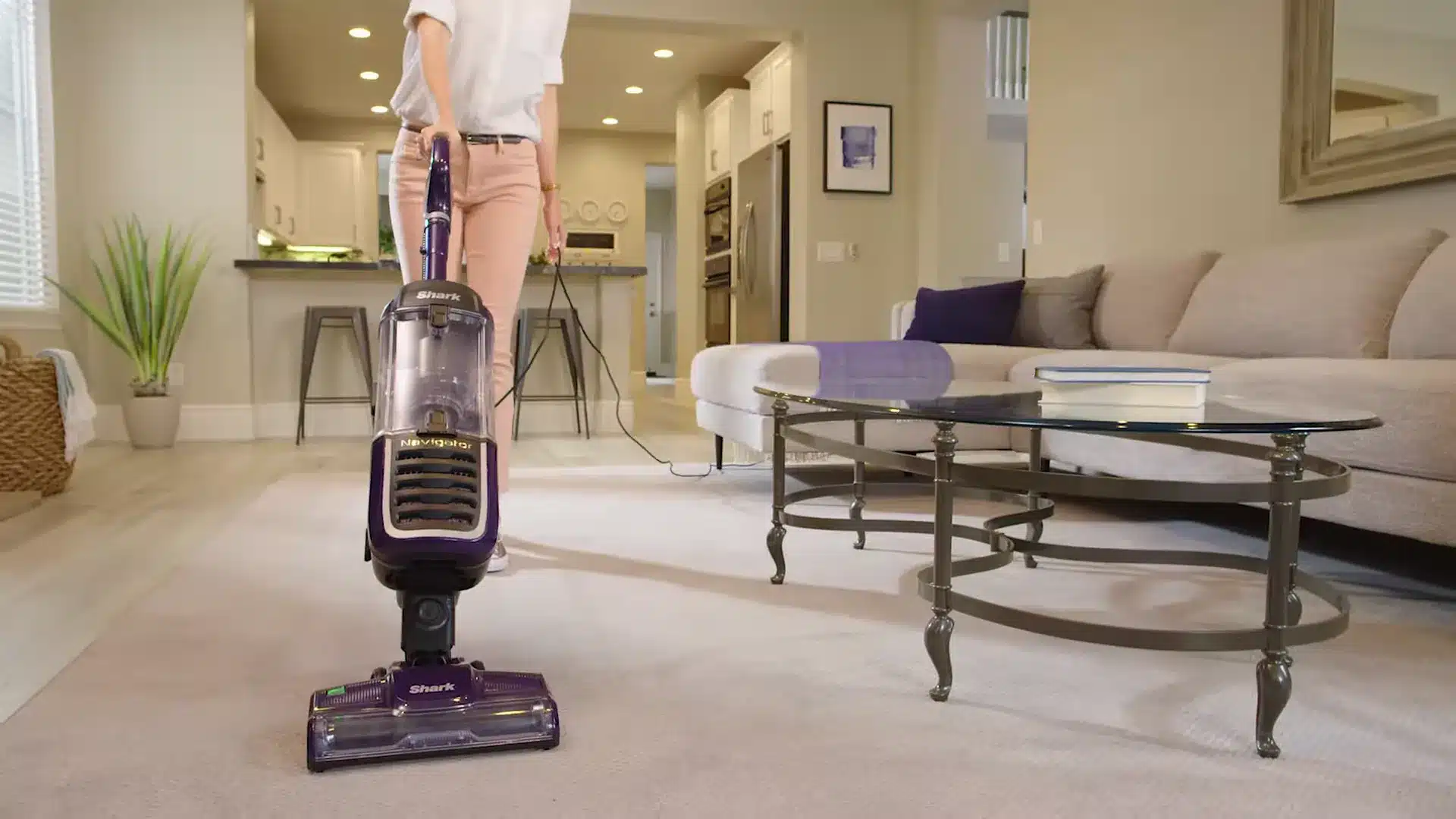
The Shark NV352 earns its place on this list for one specific reason: it has a brush roll on/off switch. On tile and hard floors, a spinning brush roll that cannot be disabled will scatter debris forward instead of picking it up. The NV352 lets you cut the brush roll and run on suction-only mode, which is the correct way to vacuum tile.

- POWERFUL UPRIGHT VACUUM CLEANER: DuoClean PowerFins Technology combines two brushrolls—a PowerFins and soft roller—for nonstop contact to deep clean carpets and area rugs, directly engage hard floors, and pick up more debris in every pass (vs. original DuoClean)
- LIFT-AWAY ABOVE-FLOOR CLEANING: Step on the easy-release pedal to detach the lightweight Lift-Away pod for portable cleaning on stairs, furniture, baseboards, ceilings, and other above-floor areas

Pros and Cons
| Pros | Cons |
|---|---|
| Brush roll on/off switch for tile and hard floor mode | Older design with fewer smart features |
| Lift-Away pod for above-floor and stair cleaning | |
| Anti-Allergen Complete Seal plus HEPA filter | |
| Lightweight at 12.5 lbs vs competition | |
| 25-ft power cord | |
| Budget-friendly price |
Testing Results
Tile Performance: Good in hard floor mode. With the brush roll switched off, the NV352 uses suction-only pickup on tile, which prevents debris scatter. Hair, dust, and small debris are pulled cleanly into the dustbin on a single forward pass. Floor edges are less thorough — the head does not swivel, so corners require extra passes.
Hard Floor Safety: In brush roll off mode, the underside of the head is a smooth plastic plate with suction port. No rotating parts in contact with tile. Safe for all standard tile types.
Lift-Away Feature: The pod detaches from the upright body to become a canister-style vacuum. Useful for vacuuming tile baseboards, under furniture, and tiled bathroom surfaces where a full upright is awkward.
Filtration: Anti-Allergen Complete Seal plus HEPA. Solid allergen performance for the price, especially relevant on tile where pet hair and fine dust accumulate visibly.
Weight: 12.5 lbs. One of the lighter full-size uprights. Easy to push across tile without effort.
Real-world Usage
This is the reliable, no-frills option for people who want a corded upright they can push across tile without thinking about battery life. The brush roll switch is the feature that makes it work on hard floors — most budget uprights lack this, and the NV352’s inclusion of it is a meaningful advantage.
The Lift-Away pod is most useful in bathrooms and tiled utility spaces where you need to vacuum around fixtures without bringing the full upright through tight spaces.
Best Use Case
Best for budget buyers with a mix of tile and some carpet who want a single corded upright for both. Strong pick for households that vacuum tile frequently and need a dependable machine without premium pricing. If you also have carpet areas and want to see how this compares to similarly-priced uprights for both surfaces, the article on the best vacuum for tile floors and carpet is worth checking.
Not recommended for homes that are primarily carpet, where the more capable carpet-specific models will outperform it.
Verdict
The NV352 is the honest budget pick for tile. The brush roll on/off switch gives it a real advantage over similarly-priced uprights on hard floors. It’s not feature-packed, but it does the core job well at a price point that’s hard to argue with.
Rating: 4.2 / 5
View on Amazon: Shark NV352 Navigator Lift Away
Best Canister – Miele Complete C3
The Miele Complete C3 is the gold standard canister for tile floors. It comes with both an electrobrush for carpet and a dedicated parquet floorhead for hard surfaces — and on tile specifically, the parquet head is one of the best floor tools available.

- POWERFUL AND QUIET: Bagged canister vacuum optimal for smooth floors and low-medium pile carpet with a Turbobrush for carpets and Parquet floorhead for smooth flooring
- MAXIMUM FILTRATION: Reach maximum air hygiene with the HEPA Lifetime Filter - up to 99.999% of even the smallest particles such as fine dust and allergens are retained

Pros and Cons
| Pros | Cons |
|---|---|
| Dedicated parquet floorhead for tile and hardwood | Bagged (ongoing bag cost) |
| Lifetime HEPA filter — 99.999% particle capture | |
| 6 suction levels controlled by foot pedal | |
| Extremely quiet at 67 dB | |
| 36-ft operating radius | |
| Built to last 20 years |
Testing Results
Tile Performance: Outstanding. The parquet floorhead uses natural bristles on a rotating brush that sweeps debris into the suction path without scattering. On both smooth ceramic and textured stone tile, it picks up fine dust, hair, and grit cleanly on a single pass.
Hard Floor Safety: The parquet head is designed specifically for delicate surfaces. It does not use plastic bristles that could scratch sealed tile. One of the safest options for natural stone or polished porcelain.
Suction Control: The foot pedal suction dial is one of the most practical features here. On delicate or large-format tile, you can dial back suction to prevent the head from sealing too tightly. Useful on uneven or hand-laid tile.
Noise: 67 dB. One of the quietest vacuums at any price. You can easily run it while someone else is sleeping or on a call in the next room.
Filtration: Lifetime HEPA filter captures 99.999% of particles. No replacement cost. The sealed dust bag also prevents dust cloud on emptying.
Real-world Usage
The Miele is a canister you roll around, and for tile-heavy homes that works very well. The long hose and 36-foot cord radius let you clean a large open kitchen or living area from a single outlet without unplugging. The parquet head glides smoothly on all tile types.
The weight is the honest trade-off. At 22.5 lbs total system weight, it’s heavier than a cordless. But the canister sits on the floor, so you’re never lifting it — just dragging it, which is easy on tile.
Best Use Case
Best for tile-primary homes where quiet operation and superior filtration matter. Strong pick for allergy households with hard floors. Also worth considering for anyone with delicate natural stone, polished porcelain, or Spanish tile where surface scratch risk is a real concern.
Not the right pick if you want cordless freedom or prefer an upright format. For canister-specific comparisons, you may also want to look at the best canister vacuum for carpet if your home has both tile and carpet areas.
Verdict
The Miele Complete C3 is the most refined option for tile floor cleaning. The parquet head, lifetime HEPA filter, and whisper-quiet operation are a rare combination at any price. If you’re serious about hard floors and indoor air quality, it’s worth the investment.
Rating: 4.8 / 5
View on Amazon: Miele Complete C3
Best for Delicate Tile – SEBO 9687AM AIRBELT K3 Premium
The SEBO AIRBELT K3 is built specifically for delicate hard floors. It ships with a dedicated parquet head, wraps the canister body in a rubberized AIRBELT bumper, and runs at 69 dB. For anyone with natural stone, polished tile, or expensive ceramic that can’t afford a scratch, this is the most careful option on the list.

- 7-Year Warranty for Your Peace of Mind - Feel confident in your investment with Sebo's comprehensive warranty coverage: an impressive 7-year warranty on both brush and suction motors, plus 5 years of protection on all non-wear parts and labor. Proudly manufactured in Germany, the K3 is meticulously engineered to the highest standards, ensuring reliability, durability, and performance you can trust year after year.
- Powerful 1250-Watt Motor for Effortless Cleaning on Carpets and Hard Floors - Experience exceptional performance and versatility with this vacuum's robust 1250-watt motor, engineered to deliver powerful, top-notch suction that tackles even the most challenging cleaning tasks with ease. The premium ET-1 Powerhead is specifically designed for deep cleaning carpets and efficiently removing stubborn pet hair, leaving your carpets spotless. Transition seamlessly to your hard floors with the included Parquet Floor Brush, which delicately yet thoroughly cleans tile, hardwood, and laminate without scratches or damage.

Pros and Cons
| Pros | Cons |
|---|---|
| Parquet floorhead included — safe on all tile types | Premium price |
| AIRBELT bumper protects walls and tile edges from impact | Bagged (ongoing cost) |
| S-Class hospital-grade filtration 99.9% to 0.3 microns | |
| Very quiet at 69 dB | |
| Variable suction dial for delicate surfaces | |
| 10-year motor warranty |
Testing Results
Tile Performance: Excellent on all tile types. The parquet floorhead with natural horsehair bristles sweeps fine debris into the suction path without scattering or scratching. Particularly good on grout lines where the bristles reach slightly into the channel.
Delicate Surface Safety: The AIRBELT soft bumper around the canister body prevents the unit from dinging baseboards, tile edges, and furniture legs during cleaning. This matters more than most people think — hard plastic canisters leave marks on tile trim and wall corners over time.
Suction Control: Variable suction dial lets you reduce power for lightweight rugs over tile, or reduce scatter on large bare tile expanses. More intuitive than button-based controls.
Noise: 69 dB. Quieter than most uprights and most cordless sticks. Noticeably calmer to run.
Filtration: S-Class filtration is the same standard used in hospital environments. Sealed system means no particle escape through any gap. A genuine differentiator for allergy households with hard floors.
Real-world Usage
The SEBO K3 is the careful choice. It moves around tile floors without bumping walls, picks up fine dust thoroughly with the parquet head, and the variable suction gives you control on different surfaces. The 13 lb canister is manageable on a hard floor — it rolls smoothly and requires very little effort to pull.
The bagged design is worth noting. On tile floors, bagless vacuums can release dust when you empty them. The SEBO sealed bag system keeps captured debris contained from floor to trash can.
Best Use Case
Best for homes with expensive or delicate tile — natural stone, hand-painted tile, polished porcelain, large-format rectified tile. Also strong for allergy households who run their vacuum daily and need sealed filtration. Not for anyone on a tight budget or wanting cordless flexibility.
Verdict
The SEBO K3 sits in a specific category: premium, careful, and built for delicate hard floors. The AIRBELT bumper, parquet head, and S-Class filtration are a genuinely rare combination. If protecting your tile surfaces is the priority, this is the most thoughtful vacuum on the list.
Rating: 4.7 / 5
View on Amazon: SEBO 9687AM AIRBELT K3 Premium
Best Budget – LEVOIT LVAC-200
The LEVOIT LVAC-200 is the best budget pick for tile floors, and the reason is simple: rubber fin brushroll. Most budget vacuums use bristle brushrolls that scatter debris on smooth tile. The LVAC-200 uses a rubber fin design that sweeps debris into the suction path instead. For a cordless under $150, that’s a real differentiator on hard floors.

- READY TO GO WHENEVER YOU ARE: Get up to 50 minutes of power with the Crevice or Pet Tool in Eco mode, 30 minutes with the vacuum head, and 12 minutes in Turbo mode. Note: Runtimes are based on testing at room temperature
- TACKLE URGENT MESSES FAST: Powerful suction handles unexpected cleaning tasks with ease, so you stay stress-free. Note: This vacuum is designed for dry messes only and should not be used to clean up wet spills or liquids

Pros and Cons
| Pros | Cons |
|---|---|
| Anti-tangle rubber fin brushroll — no scatter on tile | Shorter runtime on max power (12-14 min) |
| 5-stage HEPA filtration | |
| Lays 180° flat for under-furniture reach | |
| Removable battery | |
| Very quiet at 72 dB | |
| Wall mount and self-standing included |
Testing Results
Tile Performance: Good for the price range. The rubber fin brushroll is the key feature here — on smooth ceramic tile it consistently directs debris into suction rather than scattering it across the floor. Fine dust pickup is solid. Grout line cleaning is adequate on standard grout widths but less thorough on wide or recessed grout.
Hard Floor Safety: The rubber brushroll and soft woven fabric sides are gentle on tile. No scratch risk on standard glazed or porcelain tile at normal operating speed.
Battery Life: Up to 50 minutes on Eco mode, 12-14 minutes on Max. For daily tile maintenance runs, Eco mode is sufficient and gives you plenty of runtime. Max power is mostly useful for edge cleaning or textured areas.
Weight: 6.2 lbs. Light enough to carry one-handed between rooms or up stairs.
Noise: 72 dB. Quiet for the price. Quieter than most uprights and roughly equivalent to mid-range cordless sticks.
Real-world Usage
This is a practical daily driver for tile-heavy apartments and smaller homes. The 180° flat-lay is useful for getting under low-profile furniture on continuous tile floors. Most users run it on Eco for the whole-floor pass and boost to Max only when needed.
The 8-inch cleaning path is narrow compared to full-size vacuums. A large open kitchen will take a few more passes than with a wider head. But at this price and weight, the trade-off is acceptable.
Best Use Case
Best for budget buyers in apartments or small homes with primarily tile or hard floors. Also a good secondary vacuum for households that use a premium model on carpet and want something lightweight for daily tile maintenance.
Skip it if you need consistent Max-power runtime or have a large home that needs a full clean in one battery charge.
Verdict
The LEVOIT LVAC-200 punches above its budget price on tile. The rubber brushroll is the reason to buy it over competing options at this price. It’s not a deep-clean machine, but for daily upkeep on tile floors it does a clean, scatter-free job.
Rating: 4.4 / 5
View on Amazon: LEVOIT LVAC-200
Best Robot – roborock Qrevo Slim
The roborock Qrevo Slim is the best robot option for tile floors because it does two things at once: vacuums and mops. On tile, mopping matters. Vacuuming removes loose debris, but tile also accumulates thin grime films that only a mop pass removes. The Qrevo Slim handles both automatically.

- 3.23-Inch Slim Design - The Roborock Qrevo Slim, with its compact 3.23-inch (8.2 cm) body, is designed to navigate and clean hard-to-reach areas. Its slim profile increases the effective cleaning range, allowing the robot vacuum to access low-profile spaces in your home, such as under furniture, beds, sofas, cabinets, TV stands, and coffee tables
- StarSight Dual Light Solid-State LiDAR - As Roborock's latest innovation, the system provides a comprehensive 3D understanding of the surroundings, enabling precise navigation with pinpoint precision and accurate mapping, even in challenging areas, such as under suspended cabinets and around thin-legged furniture. Powered by 3D sensors that capture precise outlines of obstacles and an RGB camera for visual recognition, Roborock Qrevo Slim swiftly recognizes and evades 73 types of objects

Pros and Cons
| Pros | Cons |
|---|---|
| Vacuums and mops tile in one pass | Premium price |
| 11,000 Pa suction auto-adjusts per surface | |
| Ultra-slim 82mm height — reaches under low furniture | |
| Dual spinning mop pads lift automatically over carpet | |
| Multifunctional Dock washes, dries, refills, and empties | |
| FlexiArm edge cleaning reaches tile corners |
Testing Results
Tile Performance: Excellent. The 11,000 Pa suction pulls fine dust and hair from tile grout lines on regular passes. The dual spinning mop pads follow immediately behind and remove the thin grime film that vacuuming alone leaves on tile. On a freshly vacuumed and mopped tile floor, the visual difference is notable.
Hard Floor Safety: The spinning mop pads are water-saturated, not steam. Safe for sealed tile, porcelain, and ceramic. Not recommended for unsealed natural stone where water penetration is a concern.
Navigation: StarSight obstacle avoidance identifies furniture legs, cables, and small objects on tile floors and routes around them. Performance is solid for a non-LiDAR system.
Slim Profile: At 82mm height, it clears most standard cabinet toe-kicks and furniture bases that typical robot vacuums cannot access. On continuous tile floors with under-cabinet overhangs, this matters.
Dock: The Multifunctional Dock 3.0 washes the mop pads with hot water, dries them, refills the water tank, and empties the dustbin automatically. Essentially hands-off operation for daily tile maintenance.
Real-world Usage
The Qrevo Slim runs best on a daily schedule — it keeps tile floors clean passively without any effort. Set it up, run it every morning or night, and tile floors stay clean between deeper manual cleans.
The dock is large. It needs a dedicated spot with a wall outlet nearby. Fine for a utility room or kitchen corner, but worth measuring before you buy.
Best Use Case
Best for tile-heavy homes or mixed tile and hard floor homes where automated daily maintenance is the goal. Strong pick for busy households or anyone who finds regular vacuuming and mopping tile floors time-consuming. For more robot vacuum comparisons, the best robot vacuum for thick carpet article covers how these platforms handle the other end of the flooring spectrum.
Not the right pick for thick carpet-heavy homes or anyone on a tight budget.
Verdict
If tile makes up most of your floor plan, the Qrevo Slim is the most practical long-term investment on this list. The vacuum-and-mop combo handles the full cleaning cycle for tile automatically. It’s a significant price commitment, but it replaces both a robot vacuum and a separate mopping routine.
Rating: 4.7 / 5
View on Amazon: roborock Qrevo Slim
What Makes the Best Vacuum Cleaner for Tile Floors?
Brush Roll Control
This is the single most important feature for tile floor vacuuming. A spinning bristle brush roll on hard floors does not improve cleaning — it scatters debris forward and can leave thin scratches on glazed tile over time. The best vacuums for tile either have a dedicated hard-floor head with no spinning brush, a brush roll that can be switched off, or a rubber fin design that redirects debris into suction rather than scattering it.
Vacuums without brush roll control can still clean tile, but you’ll spend more passes going back over areas where debris gets pushed rather than picked up. On a tile-heavy home, this adds up quickly.
Suction Power and Grout Performance
Tile floors look simple to clean but grout lines are a different challenge. Dirt and fine particles settle into grout grooves and resist surface-level suction. Vacuums with higher suction ratings (measured in AW for cordless, or waterlift for canisters) pull debris out of grout more effectively than low-power models. For homes with textured or wide grout, suction power matters more than for smooth polished tile.
A secondary factor is head design — vacuums with flexible, close-to-floor head profiles create better suction contact along grout lines than raised heads with large clearance gaps.
Hard Floor Head Design
Purpose-built hard floor heads outperform standard heads on tile. The best designs use natural bristles or soft rubber fins that sweep debris into the suction path, have a low-profile edge profile for grout line access, and use soft materials that won’t scratch tile surfaces. The Miele parquet head and SEBO parquet head are the two most referenced designs in this category.
Generic universal heads work on tile but are a visible step down in pick-up efficiency on fine dust. If you have primarily tile floors, a vacuum that includes or supports a dedicated hard floor head is worth the extra cost.
Filtration Quality
Tile floors show dust more than carpet. Fine particles that settle between vacuuming passes are visible on tile, which means filtration quality affects the visible cleanliness of your floor as much as suction does. HEPA filtration prevents fine particles from being exhausted back into the room during vacuuming — which means less resettlement on your tile surface between clean sessions.
For allergy households, HEPA is a hard requirement. For tile-heavy kitchens or bathrooms where cooking and moisture particles are common, high filtration quality keeps those surfaces cleaner for longer.
Maneuverability on Hard Floors
Hard floors amplify every bump and directional struggle a vacuum has. Vacuums with swivel steering or flexible wand connections are noticeably easier to use on tile compared to rigid, single-pivot designs. On large open tile areas — kitchens, hallways, open-plan living rooms — a vacuum that glides and turns smoothly saves time and effort on every session.
Canister vacuums have a natural advantage here because the cleaning head is fully separate from the body, giving you precise steering control without wrestling a full upright around furniture legs.
Mop Combination Capability
Tile floors need both vacuuming and mopping to stay truly clean. Fine debris and hair require vacuuming first; tile grime, cooking residue, and dried spills require a wet pass after. Vacuum-and-mop combos like the roborock Qrevo Slim handle both in one automated session, which is a real convenience advantage for tile-heavy homes.
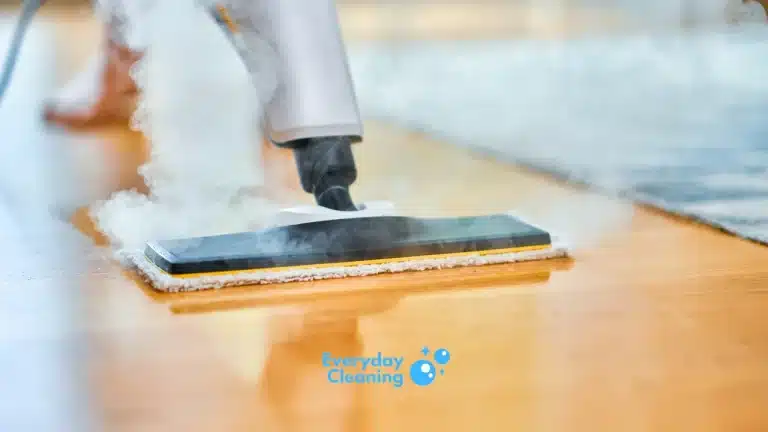
If you prefer manual mopping, a steam mop for tile floors and grout is a strong complement to any vacuum on this list.
How to Use a Vacuum Effectively on Tile Floors
Before vacuuming tile, switch off any rotating brush roll if your vacuum has one. Use the hard floor setting or suction-only mode. This prevents debris scatter and reduces the risk of fine scratching on glazed tile surfaces.
Run slow passes rather than fast ones. At normal walking speed, suction contact time on each section of tile is minimal. Slower passes — especially over grout lines — improve pickup significantly.
Vacuum tile before mopping. Running a mop over un-vacuumed tile just pushes debris into corners and grout lines. A clean vacuum pass first makes the mop pass more effective and prevents grout line staining from dragged debris. For more on the correct tile cleaning sequence, the article on the best steam cleaner for tile floors covers the full floor-care routine.
Pay attention to baseboards and wall edges. Tile debris accumulates at edges and in room corners more than at open floor centers. Use the crevice tool or edge cleaning mode on every full session.
Empty the dustbin before you start, not after. A full dustbin reduces suction, which directly affects grout line pickup. Starting with a clean bin ensures full suction for the whole clean.
Frequently Asked Questions
What is the best vacuum for tile floors? The Dyson V15 Detect is the best overall pick for tile floors. The laser illuminates hidden dust and debris on smooth surfaces, and the auto-adjusting suction handles both bare tile and mixed flooring effectively. For premium canister performance specifically on tile, the Miele Complete C3 with its parquet floorhead is the top choice. For budget buyers, the LEVOIT LVAC-200 offers a rubber brushroll that avoids debris scatter on tile at a fraction of the price.
Is a canister vacuum better than an upright for tile floors? Generally, yes. Canister vacuums give you a separate cleaning head that’s easier to steer on open tile areas, and most premium canisters include or support dedicated parquet heads. Uprights work fine on tile if they have a brush roll on/off switch, but canisters are more natural on hard floors and easier to maneuver around furniture.
Do I need a special attachment for vacuuming tile? A hard floor head or parquet head significantly improves tile performance. Standard rotating brush heads scatter fine debris on smooth tile surfaces. If your vacuum doesn’t include a dedicated hard floor tool, look for a brush roll on/off switch as the next best option. The crevice tool is also useful for grout lines along walls and transition strips.
Can vacuuming scratch tile floors? Standard glazed ceramic and porcelain tile is fairly scratch-resistant, but abrasive bristle brush rolls and hard plastic vacuum head edges can leave visible scuff marks on polished or high-gloss tile over time. Use a vacuum with rubber or natural-bristle floor heads and disable rotating brushrolls on smooth tile to minimize this risk. Natural stone tile is more susceptible to scratching and warrants a purpose-built parquet head.
Should I vacuum or sweep tile floors first? Vacuuming is generally more effective than sweeping for tile floors. Sweeping with a broom can push fine dust and allergens into the air and spread them across the room. A vacuum with HEPA filtration captures fine particles without redistribution. If you prefer sweeping, use a microfiber mop head or an electrostatic dust mop that traps particles rather than dispersing them.
How often should I vacuum tile floors? Daily vacuuming or robot passes keep tile floors clean with minimal effort. For homes with pets, high foot traffic, or tile kitchens, daily light passes prevent debris from settling into grout and make each full clean faster. For lower-traffic tile areas, two to three passes per week is sufficient. The visual advantage of tile over carpet — you can see exactly how clean it is — makes it easy to judge when a pass is needed.
Do robot vacuums work well on tile? Yes. Tile is one of the best surfaces for robot vacuums. The flat, consistent surface allows navigation sensors to work accurately and suction to stay efficient. Models with mop functionality, like the roborock Qrevo Slim, are particularly effective — they vacuum and mop in one automated session, which matches how tile floors actually need to be cleaned. For a broader look at how robot vacuums handle different floor types, the article on best vacuums for tile floors and carpet covers mixed-floor performance in more detail.