
Choosing the Right Zipper Type for Your Clothes

Whether you’re fixing your favorite jacket, or working on a DIY sewing project, picking the right zipper types can make or break your garment. A good zipper should glide smoothly, hold securely, and last through countless wears and washes. But with so many options out there—metal, plastic, coil, invisible—how do you know which one fits your needs?
In this guide, we’ll walk you through everything you need to know about zipper types, from understanding their basic parts to choosing the perfect one for different fabrics and garments. You’ll also learn how to measure zippers correctly, spot durable options, and keep them in great shape for years to come.
Table of Contents
Parts of a Zipper

Understanding these parts helps you shop smarter and troubleshoot problems when they arise.
Slider: This is the little piece you pull up and down to open and close the zipper. Inside the slider, there’s a mechanism that locks the teeth together or pulls them apart.
Teeth/Element: These are the interlocking pieces that run along both sides of the zipper tape. They can be made from metal, plastic, or coil, depending on the zipper type.
Tape: The fabric strip that holds the teeth in place. It’s usually made from polyester or cotton and gets sewn into your garment.
Pull Tab: The small handle attached to the slider that you grip when zipping or unzipping.
Top Stop: This piece sits at the top of the zipper and prevents the slider from sliding off completely.
Bottom Stop: Found at the bottom, it keeps the two sides of the zipper aligned and stops the slider from coming off the other end.
Separating vs. Non-Separating: Some zippers come apart completely at the bottom (separating), like on jackets. Others stay connected (non-separating), like on pants or bags.
Now that you know the basics, let’s explore the main zipper types you’ll encounter.
Classification of Zipper Types
Metal Zippers

Metal zippers feature teeth made from aluminum, brass, or nickel. They have a classic, sturdy appearance and produce that distinctive zipping sound many people recognize.
Advantages:
- Extremely durable and long-lasting
- Strong enough to handle heavy fabrics like denim and leather
- Adds a stylish, vintage, or industrial look to garments
- Resistant to heat and won’t melt under an iron
Disadvantages:
- Heavier than plastic or coil options
- Can rust or tarnish over time, especially in humid conditions
- May corrode if exposed to salt water or harsh chemicals
- More expensive than other zipper types
Best Suited For: Jeans, leather jackets, heavy coats, workwear, and bags. Metal zippers work perfectly for garments that need extra strength and a rugged aesthetic. They’re ideal when you want your zipper to be both functional and a design feature, like on biker jackets or vintage-inspired pieces.
Coil Zippers (Nylon Zippers)
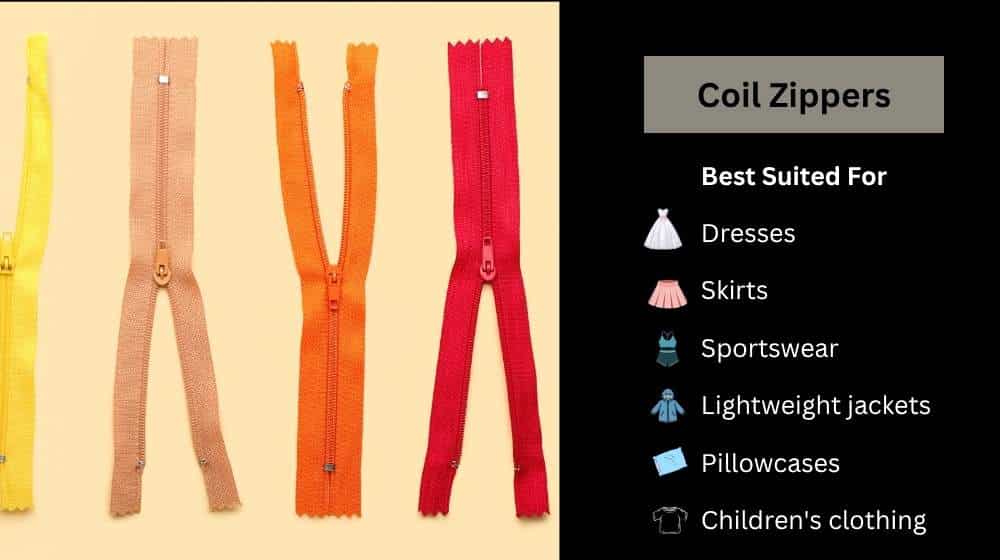
Coil zippers use a continuous spiral of nylon or polyester monofilament as their teeth. This creates a smooth, flexible closure that bends easily with the fabric.
Advantages:
- Lightweight and flexible, perfect for curved seams
- Won’t snag or catch on delicate fabrics
- Self-repairing—if the teeth come apart, you can often zip them back together
- Water-resistant and corrosion-proof
- Budget-friendly and available in countless colors
Disadvantages:
- Less durable than metal for heavy-duty applications
- Can break or separate under extreme stress
- May melt if exposed to high heat from irons or dryers
- Not as strong as metal or molded plastic zippers
Best Suited For: Dresses, skirts, sportswear, lightweight jackets, pillowcases, and children’s clothing. Coil zippers shine in garments that need flexibility and a smooth finish. They’re especially good for knits and stretchy fabrics that move with your body.
Vislon Zippers (Molded Plastic Zippers)
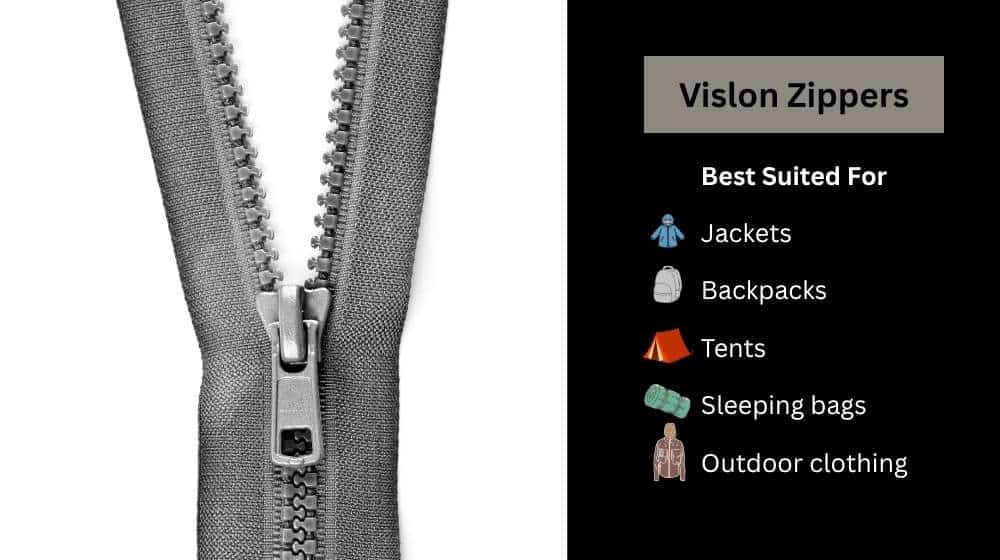
Vislon zippers have individual teeth molded from polyacetal resin directly onto the tape. Each tooth is a separate, chunky piece that interlocks with the others.
Advantages:
- Stronger than coil but lighter than metal
- Completely waterproof and rustproof
- Smooth operation with minimal snagging
- Durable enough for outdoor gear and activewear
- Good color retention and available in bright hues
Disadvantages:
- Bulkier appearance than coil zippers
- Can feel stiff on lightweight fabrics
- Not as strong as metal for very heavy materials
- Limited flexibility compared to coil options
Best Suited For: Jackets, backpacks, tents, sleeping bags, and outdoor clothing. Vislon zippers are the go-to choice when you need water resistance and durability without the weight of metal. They’re perfect for sportswear, rain gear, and camping equipment where moisture protection matters.
Invisible Zippers
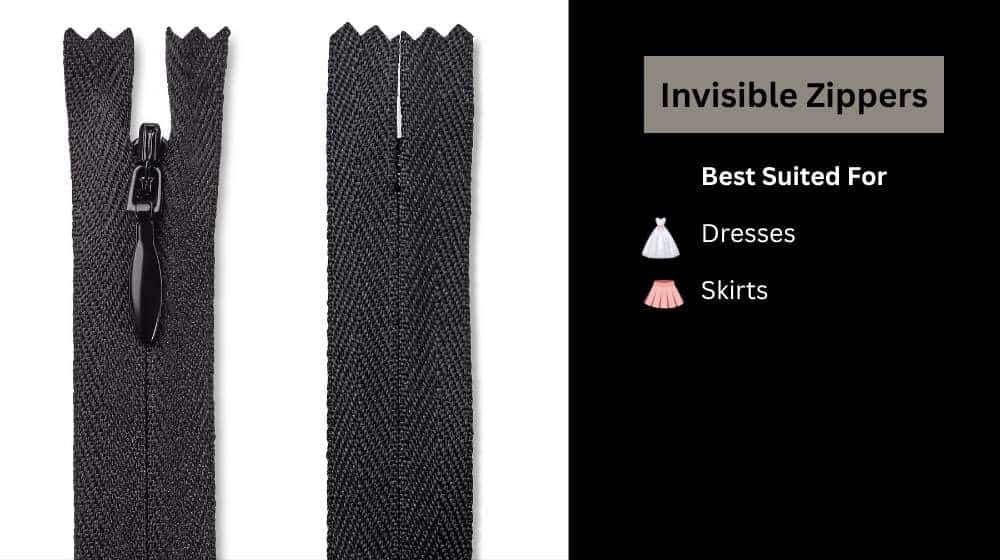
Invisible zippers hide completely behind the fabric seam, with only a small pull tab visible. The teeth face the back of the tape and disappear into the seam when installed correctly.
Advantages:
- Creates a seamless, professional finish
- Doesn’t interrupt the fabric pattern or design
- Ideal for formal wear and elegant garments
- Lighter and less bulky than standard zippers
Disadvantages:
- Requires a special invisible zipper foot for installation
- More difficult to sew in than regular zippers
- Less durable than exposed zippers
- Limited availability in heavy-duty sizes
Best Suited For: Dresses, skirts, formalwear, and any garment where you want the zipper to disappear. Invisible zippers work beautifully on evening gowns, bridesmaid dresses, and tailored garments where a visible zipper would distract from the overall design.
Open-End (Separating) Zippers

These zippers split completely into two separate pieces at the bottom. They’re the type you see on jackets and hoodies that you can take on and off easily.
Advantages:
- Convenient for outerwear that opens completely
- Available in all tooth types (metal, coil, Vislon)
- Easy to put on and take off
- Suitable for both lightweight and heavy garments
Disadvantages:
- More expensive than closed-end zippers
- The bottom insert box can sometimes be tricky to align
- Slightly heavier due to the separating mechanism
Best Suited For: Jackets, coats, hoodies, vests, and cardigans. Any garment that you need to open completely benefits from a separating zipper. They’re essential for outerwear and make getting dressed much easier.
Closed-End (Non-Separating) Zippers
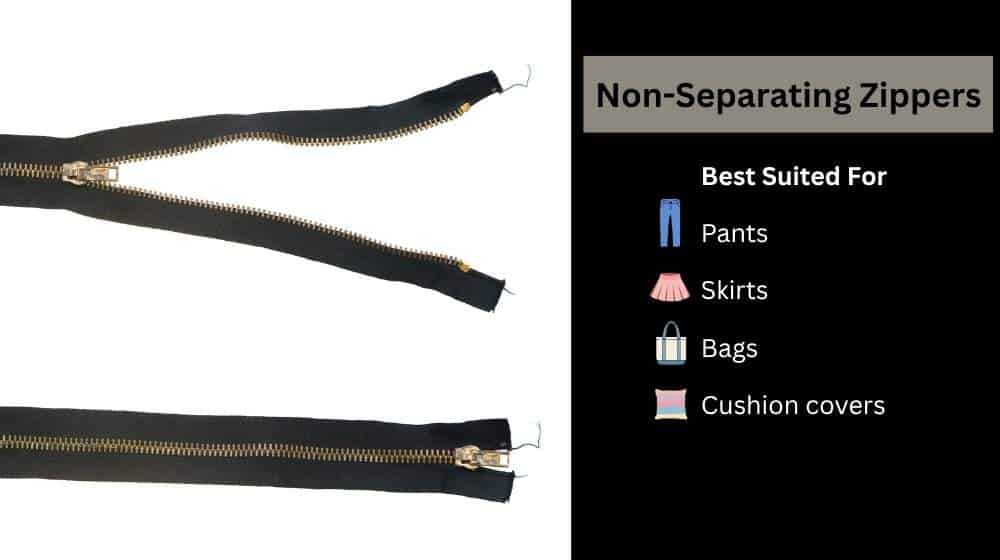
These zippers stay connected at the bottom and only open partway. They’re permanently attached at both ends.
Advantages:
- Simpler construction means lower cost
- Lighter weight than separating zippers
- Easy to install in most garments
- Available in every size and style
Disadvantages:
- Can’t be fully opened
- Not suitable for jackets or cardigans
- Limited to partial-opening applications
Best Suited For: Pants, skirts, bags, cushion covers, and any item that only needs a partial opening. These are your everyday zippers for most sewing projects where you don’t need the garment to separate completely.
Two-Way Zippers
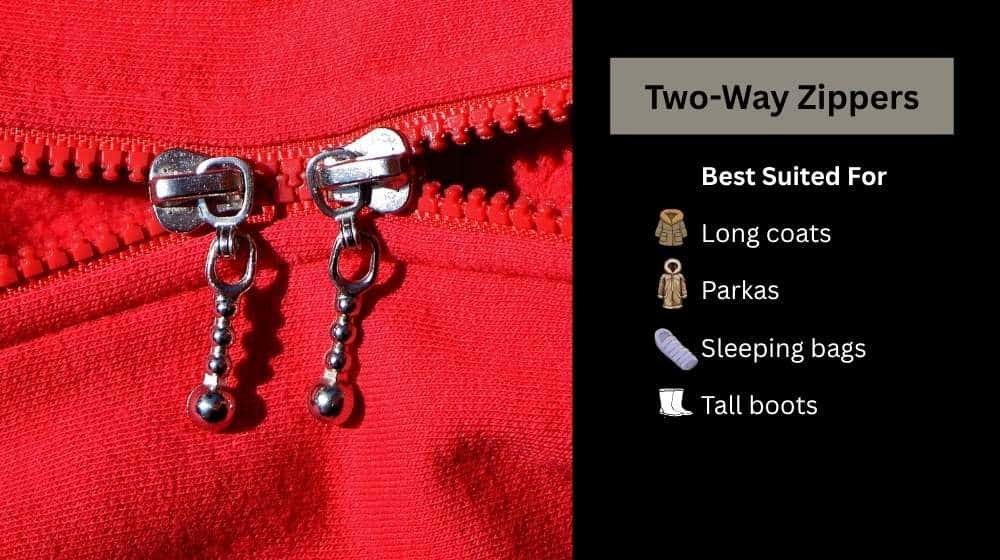
These feature two sliders that can open the zipper from both the top and bottom simultaneously. They give you ventilation options and movement flexibility.
Advantages:
- Allows ventilation without fully opening the garment
- Provides more freedom of movement
- Convenient for sitting or bending while wearing long coats
- Adds functionality to outdoor gear
Disadvantages:
- More expensive than single-slider zippers
- Heavier and bulkier
- More complex mechanism can fail if not maintained
- Overkill for simple garments
Best Suited For: Long coats, parkas, sleeping bags, and tall boots. Two-way zippers are fantastic for winter coats where you want to sit comfortably without bunching up the fabric. They’re also popular on technical outdoor gear where adjustable ventilation matters.
How to Choose the Right Zipper for Your Needs
Picking the perfect zipper isn’t just about grabbing whatever’s on sale. You need to match the zipper type to your fabric, project, and how the garment will be used. Here’s what to consider.
Key Factors to Consider When Choosing Zipper Types
1. Based on Fabric Weight
Your fabric weight should guide your zipper choice more than anything else. Use a heavy-duty metal or chunky Vislon zipper on delicate silk, and you’ll end up with puckering and a garment that pulls awkwardly. Pick a flimsy coil zipper for thick denim, and it’ll break in weeks.
Lightweight fabrics (chiffon, silk, thin cotton, jersey): Stick with fine coil zippers (#3 or smaller) or invisible zippers. These won’t weigh down the fabric or create visible bulk. The flexibility of coil zippers helps them move with drapey fabrics without creating stiff lines.
Medium-weight fabrics (cotton poplin, linen, chambray, light wool): You have the most flexibility here. Standard coil zippers (#3 to #5) work great, as do plastic Vislon zippers if you need more durability. Metal zippers in smaller sizes (#3 to #5) can also work if they fit your aesthetic.
Heavy-weight fabrics (denim, canvas, leather, thick wool, upholstery): Go for metal zippers (#5 and up) or heavy-duty Vislon zippers. These materials need strong teeth that won’t separate under stress. The tape also needs to be sturdy enough to handle thick seam allowances and repeated use.
2. Based on Purpose and Usage
Think about how often the zipper will be used and what kind of stress it’ll face. A zipper on pants that you wear every day needs to be tougher than one on a decorative pillow you rarely touch.
Everyday wear (jeans, jackets, work clothes): Choose durable options like metal or Vislon zippers. These can handle hundreds of open-close cycles and washing machine abuse. YKK brand zippers are worth the small extra cost here—they’re industry-standard for reliability.
Occasional wear (party dresses, formalwear, seasonal items): Standard coil or invisible zippers work fine. You don’t need heavy-duty construction since these garments get worn less frequently and treated more carefully.
Outdoor and activewear (hiking jackets, camping gear, rain coats): Vislon zippers win here. They’re waterproof, lightweight, and stand up to dirt, moisture, and temperature changes. Two-way zippers add convenience for long coats and sleeping bags.
Home décor (cushions, bags, upholstery): Closed-end coil or Vislon zippers work well. Match the zipper size to the project scale—bigger bags need bigger zippers (#7 to #10), while small cushions can use #3 to #5.
3. Consider Aesthetic Factors
Your zipper should complement your garment’s overall look, not fight against it. Sometimes the zipper needs to disappear completely. Other times, it’s a statement piece.
Invisible finish: Choose invisible zippers or very fine coil zippers in matching colors. Install them carefully so they truly disappear into the seam. This works best for elegant, minimalist designs where hardware would be distracting.
Decorative element: Metal zippers with contrasting colors or chunky teeth can become design features. Gold or brass zippers look gorgeous on black leather. Bright plastic Vislon zippers add a sporty, modern vibe to activewear.
Color matching: Zippers come in hundreds of colors, but you don’t always need a perfect match. Sometimes a slightly darker or lighter shade blends in better than an exact match that somehow still looks off. For prints and patterns, match the zipper to the background color rather than accent colors.
Professional vs. casual: Invisible zippers scream “professionally made,” while exposed metal zippers have a more casual, rugged feel. Think about the vibe you want your finished garment to project.
How to Measure Zippers Correctly
Buying the wrong zipper length is frustrating and wasteful. Here’s how to measure and read zipper specifications so you get it right the first time.
How to Read Zipper Specifications
Zippers are measured from the top stop to the bottom stop—basically, the length of the teeth, not including the tape extension. When you see “#5 metal zipper, 7 inches,” that means:
- #5 = tooth size (5mm wide)
- Metal = tooth material
- 7 inches = length from stop to stop

The tape will extend about an inch beyond each stop, giving you room to sew it into your garment. Don’t count this extra tape in your measurement—it’s just seam allowance.
Step-by-Step Measuring Guide
For a zipper you already own:
- Lay the zipper flat and fully closed
- Measure from the top metal/plastic stop to the bottom stop
- Use a measuring tape and read in inches or centimeters
- Note the tooth width to determine the size number
For a garment opening:
- Measure the seam opening where the zipper will go
- Add about 1 inch for seam allowance if you’re replacing a zipper
- For new projects, measure the pattern piece’s zipper placement line
- Round to the nearest standard size (most zippers come in 1-inch increments)
If you’re between sizes, size down for invisible zippers (they hide better when slightly short) and size up for separating zippers on jackets (you want full coverage).
Zipper Size Chart
Here’s a quick reference for common zipper sizes and their typical uses:
Most home sewing projects use #3 to #5 zippers. Anything bigger usually goes into bags, outdoor gear, or upholstery.
How to Identify a Durable Zipper
Not all zippers are created equal. Some will last decades, while others fail after a few months. Here’s what makes a zipper truly durable.
What Makes a Zipper Durable?
Tooth construction: Uniform, evenly spaced teeth that interlock smoothly indicate quality manufacturing. Look closely—do the teeth line up perfectly on both sides? Are there any gaps or deformities? Good zippers have teeth that feel consistent when you run your finger along them.
Slider quality: The slider should glide smoothly without catching or requiring force. High-quality sliders are made from die-cast metal (even on plastic zippers) rather than stamped metal. Check the pull tab attachment—it should be secure with no wobbling.
Tape strength: Grab both sides of the closed zipper and pull gently. The tape shouldn’t stretch or distort. Quality zipper tape is tightly woven and reinforced, often with multiple rows of stitching securing the teeth. Polyester tape lasts longer than cotton in most applications.
Brand reputation: YKK (Yoshida Kōgyō Kabushikigaisha) dominates the quality zipper market for good reason. They invest heavily in quality control and innovation. Other reliable brands include Opti, Riri, and Lampo. Generic no-name zippers vary wildly in quality.
Corrosion resistance: For metal zippers, check what material they use. Brass and nickel-plated brass resist corrosion better than plain aluminum. For plastic options, high-quality polyacetal resin (Vislon) beats cheap polyester every time.
Smooth operation: Test the zipper before buying if possible. It should zip and unzip smoothly without jerking, catching, or requiring excessive force. If it’s sticky or rough when brand new, it’ll only get worse with use.
Self-locking slider: Better zippers include a self-locking mechanism that holds the slider in place without it sliding down on its own. Flip the pull tab down, and the zipper should stay put. This prevents embarrassing wardrobe malfunctions and extends zipper life by reducing stress on the teeth.
For critical garments like winter coats or work pants you wear daily, spending an extra dollar or two on a quality zipper pays off in years of reliable service.
FAQs
Which zipper type is the most durable?
Metal zippers are generally the most durable, especially in sizes #5 and larger. They can last decades with proper care and handle heavy fabrics and frequent use better than plastic alternatives. However, Vislon (molded plastic) zippers come close in durability while offering water resistance and lighter weight. For absolute maximum lifespan, choose a quality metal zipper from a reputable brand like YKK.
Can you shorten a zipper?
Yes, you can shorten most zipper types, though the method varies. For closed-end zippers, you cut from the top, create a new top stop with hand stitching or a metal stop, and trim the excess. For separating zippers, it’s trickier—you typically cut from the bottom and need to add a new bottom stop and insertion pin, which requires some skill. If you’re not confident, buying the correct length is easier. Coil zippers are the most forgiving to shorten since you can hand-stitch a bar tack to create a new stop.
What’s the difference between #3, #5, and #8 zippers?
The numbers refer to the approximate tooth width in millimeters. A #3 zipper has teeth about 3mm wide, #5 has 5mm teeth, and #8 has 8mm teeth. Bigger numbers mean stronger, more visible zippers for heavier fabrics. Use #3 for lightweight dresses and skirts, #5 for jeans and medium jackets, and #8 for heavy outdoor gear, sleeping bags, or large bags. The strength and visual impact increase with size.
Are YKK zippers really better than others?
Generally, yes. YKK controls about 50% of the global zipper market because they maintain strict quality standards, invest in research, and vertically integrate their manufacturing (they make everything from the raw materials to the finished zipper). Their zippers consistently perform better and last longer than generic alternatives. However, they cost more, so for low-stress applications like decorative pillows, generic zippers work fine. For daily-wear garments, YKK is worth it.
How do you care for metal zippers to prevent rust?
Keep metal zippers dry and clean. After exposure to water, especially salt water, rinse with fresh water and dry thoroughly. Store garments in low-humidity areas and avoid leaving damp items in plastic bags. If rust appears, try rubbing the teeth with a pencil eraser or very fine sandpaper, then apply a tiny amount of wax or silicone lubricant to restore smooth operation. Brass and nickel-plated zippers resist rust better than aluminum. Regular cleaning and occasional lubrication with zipper lubricant or even a wax candle extends their life significantly.
What’s the main difference between coil and Vislon zippers?
The numbers refer to the approximate tooth width in millimeters. A #3 zipper has teeth about 3mm wide, #5 has 5mm teeth, and #8 has 8mm teeth. Bigger numbers mean stronger, more visible zippers for heavier fabrics. Use #3 for lightweight dresses and skirts, #5 for jeans and medium jackets, and #8 for heavy outdoor gear, sleeping bags, or large bags. The strength and visual impact increase with size.
What is a waterproof zipper?
Waterproof zippers use special design features to prevent water penetration. True waterproof versions (not just water-resistant) typically use Vislon teeth with additional laminated or bonded tape that creates a seal when closed. Some high-end waterproof zippers also incorporate rubber or polyurethane film on the back of the tape. They’re essential for dry suits, survival gear, and high-end rain jackets. For casual water resistance, standard Vislon zippers work fine with a DWR (durable water repellent) coating.
How do you choose a zipper color that matches your fabric?
Bring a fabric swatch when shopping for zippers if possible. For solid colors, aim for a shade slightly darker than your fabric—it tends to blend better than lighter shades. For patterned fabrics, match the background color or the most dominant color, not the accent shades. If you can’t find a perfect match, neutral tones (black, navy, brown, beige) blend surprisingly well with many colors. When in doubt, test by laying the zipper on the fabric under good lighting before committing. For statement zippers, feel free to use contrasting colors or metallics as design elements.
Choosing the right zipper types doesn’t have to be complicated. Match the zipper to your fabric weight, think about how the garment will be used, and don’t skip quality for a few cents in savings. Whether you need a heavy-duty metal zipper for your new denim jacket or an invisible zipper for that bridesmaid dress you’re hemming, understanding these basics helps you shop confidently and create garments that last.


