HEPA Filter Maintenance: How to Clean, Check, and Replace Them

Table of Contents
A HEPA filter that is not maintained loses most of its effectiveness without showing obvious signs of failure. The vacuum or air purifier keeps running. Suction may feel normal. But the filter is no longer capturing what it is supposed to capture.
HEPA filter maintenance is straightforward once you know what type of filter you have and what it needs.
What a HEPA Filter Actually Does
HEPA stands for High Efficiency Particulate Air. A true HEPA filter captures 99.97% of particles at 0.3 microns or larger. This includes dust mite waste, pollen, mold spores, pet dander, and fine particulate matter.
The filter works through a dense mat of randomly arranged fibers. Particles get trapped through a combination of interception, impaction, and diffusion depending on their size. The tighter the mat, the more it captures, and the more it restricts airflow as it fills up.
This is why maintenance matters. A clean HEPA filter captures more and allows better airflow. A clogged one does neither.
Washable vs. Non-Washable HEPA Filters
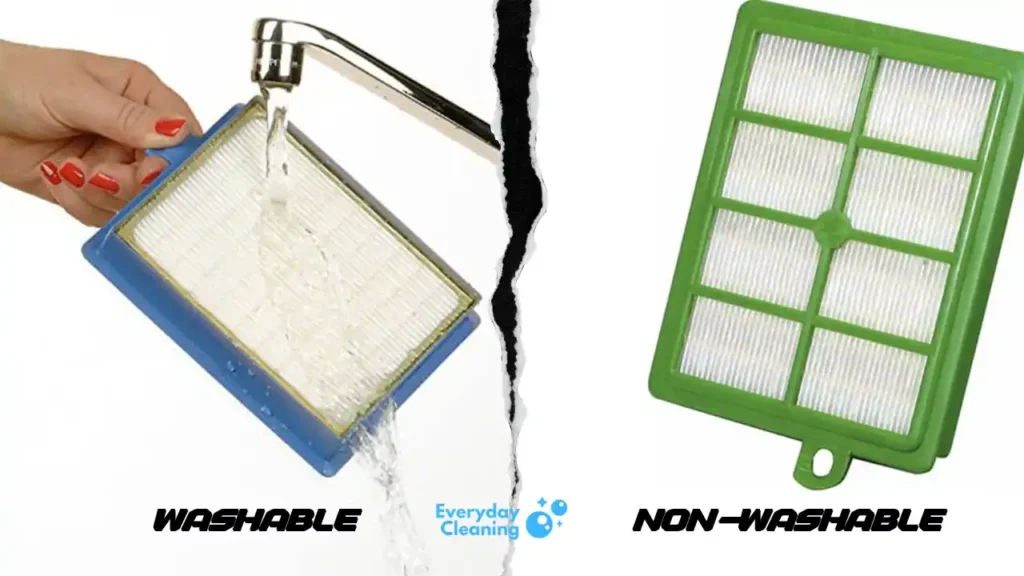
This is the most important distinction in HEPA maintenance. Getting it wrong damages the filter.
- Washable (permanent) HEPA filters are designed to be rinsed with water and reused. They are typically thicker, often gray or blue, and labeled “washable” or “permanent” in the product documentation.
- Non-washable HEPA filters use a pleated paper or glass fiber media that collapses and loses its filtration structure when wet. Water destroys them. These must be dry-cleaned or replaced.
Before doing anything to a HEPA filter, check the vacuum or air purifier manual. If it says washable, you can rinse it. If it does not explicitly say washable, treat it as non-washable.
How to Clean a Washable HEPA Filter
Step 1: Remove the Filter
Unplug the vacuum or air purifier before opening the filter compartment. Remove the filter carefully. Tap it gently over a trash bin to knock off the bulk of loose debris before doing anything else.
Do this outside or over a large bin. Tapping a clogged HEPA filter indoors releases a cloud of captured particles back into the air.
Step 2: Rinse Under Cold Water
Hold the filter under cold running water. Let the water run through from the clean side to the dirty side, pushing debris out. Do not use hot water. Heat can warp the filter frame or damage the fiber media.
Do not scrub the filter with a brush or cloth. The fiber mat is fragile. Scrubbing collapses fibers and creates gaps that particles pass through.
Rinse until the water running off the filter runs clear.
Step 3: Shake Off Excess Water
Shake the filter gently to remove as much water as possible. Do not wring or squeeze it.
Step 4: Air Dry Completely
This step is non-negotiable. A HEPA filter reinstalled while still damp promotes mold growth inside the machine and reduces filtration efficiency.
Leave the filter to air dry in a well-ventilated area for a minimum of 24 hours. In humid conditions, 48 hours is safer. Do not use a hair dryer, oven, or direct sunlight to speed drying. Heat warps the filter.
Do not reinstall the filter until it is completely dry throughout, not just on the surface.
How to Clean a Non-Washable HEPA Filter
Non-washable filters cannot be rinsed. The options are dry tapping and replacement.
Dry tapping: Remove the filter and tap it gently against the inside of a trash bin to dislodge loose surface debris. This extends usable life slightly but does not restore the filter to anything close to its original efficiency. It is a temporary measure, not maintenance.
Gentle vacuuming: Some manufacturers allow carefully vacuuming the outer surface of non-washable HEPA filters with a brush attachment on low suction. This removes surface debris without water. Do not press the attachment into the filter pleats.
Non-washable HEPA filters in vacuums typically need replacement every 6 to 12 months depending on use. Air purifier HEPA filters last 12 to 18 months under normal use. The only reliable way to restore a non-washable filter to full performance is replacement.
How Often to Maintain HEPA Filters
| Filter Type | Cleaning | Replacement |
|---|---|---|
| Washable vacuum HEPA | Every 1–3 months | Every 2–3 years |
| Non-washable vacuum HEPA | Tap monthly | Every 6–12 months |
| Air purifier HEPA (washable) | Every 3 months | Every 2–3 years |
| Air purifier HEPA (non-washable) | Not applicable | Every 12–18 months |
These are general guidelines. Homes with pets, high dust levels, or allergy sufferers need more frequent cleaning and earlier replacement.
Most modern vacuums have a filter indicator light or alert that signals when the filter needs attention. These are useful but not always accurate. A filter can be degraded well before the indicator triggers, especially in dusty conditions.
Signs Your HEPA Filter Needs Attention
Reduced suction. A clogged filter restricts airflow through the entire system. If a vacuum that used to pick up debris easily is now struggling on the same surfaces, the filter is the first thing to check.
Visible discoloration. A gray or brown filter surface covered in visible debris is overdue for cleaning. A new HEPA filter is white or light-colored. Significant darkening means it is loaded with captured particles.
Dust or odor from the exhaust. If you can smell what the vacuum is picking up in the exhaust air, or see fine dust coming out, the filter is not capturing properly. Either it is clogged and bypassing, or it has been damaged.
Allergy symptoms increasing despite regular vacuuming. This is the practical real-world indicator. A vacuum with a failed or saturated HEPA filter redistributes allergen particles rather than capturing them. If symptoms are getting worse despite regular cleaning, the filter is the first thing to check.
If allergies are the primary concern, the vacuum matters as much as the filter. Our roundup of the best vacuum cleaners with HEPA filters covers models with sealed filtration systems that prevent bypass around the filter entirely, which is a different issue from filter saturation. And if pet dander is a specific trigger, best vacuum for allergies and pets covers models tested specifically for that combination.
HEPA Filter Maintenance for Air Purifiers
Air purifier HEPA filters follow the same washable vs. non-washable rules, but the replacement schedule differs because air purifiers run continuously rather than intermittently.
Most air purifiers have a filter reset button that tracks runtime hours rather than actual filter condition. Reset it every time you clean or replace the filter so the indicator stays accurate.
Pre-filters in air purifiers trap larger particles before they reach the HEPA layer. Cleaning the pre-filter regularly (typically monthly) extends the life of the HEPA filter significantly. A clogged pre-filter forces the HEPA to do double work.
For vacuums used specifically to reduce allergens, correct HEPA maintenance is only part of the picture. The vacuum needs a fully sealed system so air cannot bypass the filter through gaps in the housing. Our guide to the best HEPA vacuum for allergies covers what sealed filtration means in practice and which models have it.
Common HEPA Filter Mistakes
Reinstalling a damp filter. The most common and most damaging mistake. Mold grows inside the machine, and the filter media loses structure when wet fibers dry compressed against the housing.
Washing a non-washable filter. Destroys the pleated media. The filter looks fine after drying but the fiber structure has collapsed in places and it no longer captures at HEPA specification.
Tapping too hard. Aggressive tapping bends or breaks the filter frame and damages the fiber mat. Gentle taps over a bin are enough.
Assuming filter indicators are always accurate. Runtime-based indicators do not account for heavy use conditions. In a home with multiple shedding pets, a filter may need replacement well before the indicator suggests it.
Skipping pre-filter cleaning. The pre-filter is there to protect the HEPA. Ignoring it sends larger debris directly to the HEPA layer and clogs it faster.
When to Replace Instead of Clean
Some situations call for replacement regardless of maintenance history:
- The filter has a visible tear, hole, or damaged frame
- The filter was washed but was not labeled washable
- The filter has been in use for longer than the manufacturer’s maximum recommended period
- Allergy symptoms remain elevated despite recent cleaning
- The filter has a persistent odor that does not go away after drying
Replacement filters are specific to each vacuum or air purifier model. Use OEM (original manufacturer) filters where possible. Third-party HEPA filters vary significantly in actual filtration quality. Some do not meet true HEPA specification despite being labeled as HEPA. For vacuums used specifically to manage dust mite or pet allergen loads, the filter quality is not a place to cut costs. Our guide to the best vacuum for dust mite allergies includes information on filter specs worth checking before buying a replacement.
Frequently Asked Questions
Can I wash a HEPA filter with soap?
No. Soap leaves residue in the fiber media that restricts airflow and can damage the filter material. Cold water only. The rinsing action removes debris without needing any cleaning agent.
How do I know if my HEPA filter is washable?
Check the product manual or the filter itself. Washable filters are explicitly labeled “washable” or “permanent.” If there is no such label, treat it as non-washable.
What happens if I use a vacuum with a clogged HEPA filter?
Suction drops, the motor works harder and runs hotter, and the filter may start bypassing — allowing particles to pass through into the exhaust air. In allergy contexts, this means the vacuum redistributes allergens rather than capturing them.
Can I run my vacuum without the HEPA filter temporarily?
Most manufacturers advise against it. Running without a filter sends fine debris directly into the motor and exhaust. It also voids most warranties. If the filter needs replacing, replace it before using the vacuum again.
How long does a HEPA filter last?
Washable filters in vacuums typically last two to three years with proper maintenance. Non-washable vacuum filters last six to twelve months. Air purifier HEPA filters last twelve to eighteen months. Heavy use or high-dust environments shorten these timelines.