Tangled Hair Removal from Vacuum Brush Rolls (Fast and Clean)
Hair wraps around a vacuum brush roll faster than almost any other type of debris. A few weeks of regular vacuuming is enough to build up a tight, layered mass that slows the roller and kills suction. Removing it properly takes less than ten minutes.
Why Hair Tangles Around the Brush Roll
The brush roll spins at high speed to agitate carpet fibers. That same spinning motion acts like a spindle for anything long and flexible. Hair, thread, and fine string get caught on the bristles and wrap tighter with every rotation.
Once enough hair wraps around the roller, the added friction slows the spin. The motor works harder to compensate. In a worst case, the roller stops entirely and the vacuum leaves debris behind on every pass.
Tools for the Job
You do not need anything special:
- Scissors — the standard option. Works on most hair tangles.
- Seam ripper — better than scissors for packed, compressed hair. The hook blade slides under the hair layer cleanly without risk of cutting bristles.
- Stitch unpicker or craft knife — same principle as a seam ripper, good for very tight wrapping near the end caps.
- Old toothbrush — for cleaning bristle bases after hair is removed.
Pick one cutting tool and a toothbrush. That is all you need for most brush rolls.
How to Remove Tangled Hair: Step by Step
Step 1: Unplug the Vacuum
Unplug before doing anything else. The brush roll bristles are stiff and the roller can spin unexpectedly if the vacuum is powered. This step is not optional.
Step 2: Access the Brush Roll
Flip the vacuum head over. Remove the base plate by unscrewing the fasteners or using a coin to turn the slot fasteners. On most stick vacuums, the floor head detaches and opens from the side.
On robot vacuums, the brush roll typically lifts out of its end cap slots without any tools. Check the underside of the robot for a release tab or clip.
Set the base plate aside and lift out the brush roll. Note which end faces which direction before removing it.
Step 3: Pull Off Any Loose Hair First
Before cutting, pull off whatever comes off by hand. Loose surface hair at the ends of the roller often peels away without needing scissors. Remove as much as you can this way.
This reduces how much cutting is needed and shows you where the hair is most tightly packed.
Step 4: Cut Through the Hair in Two or Three Places
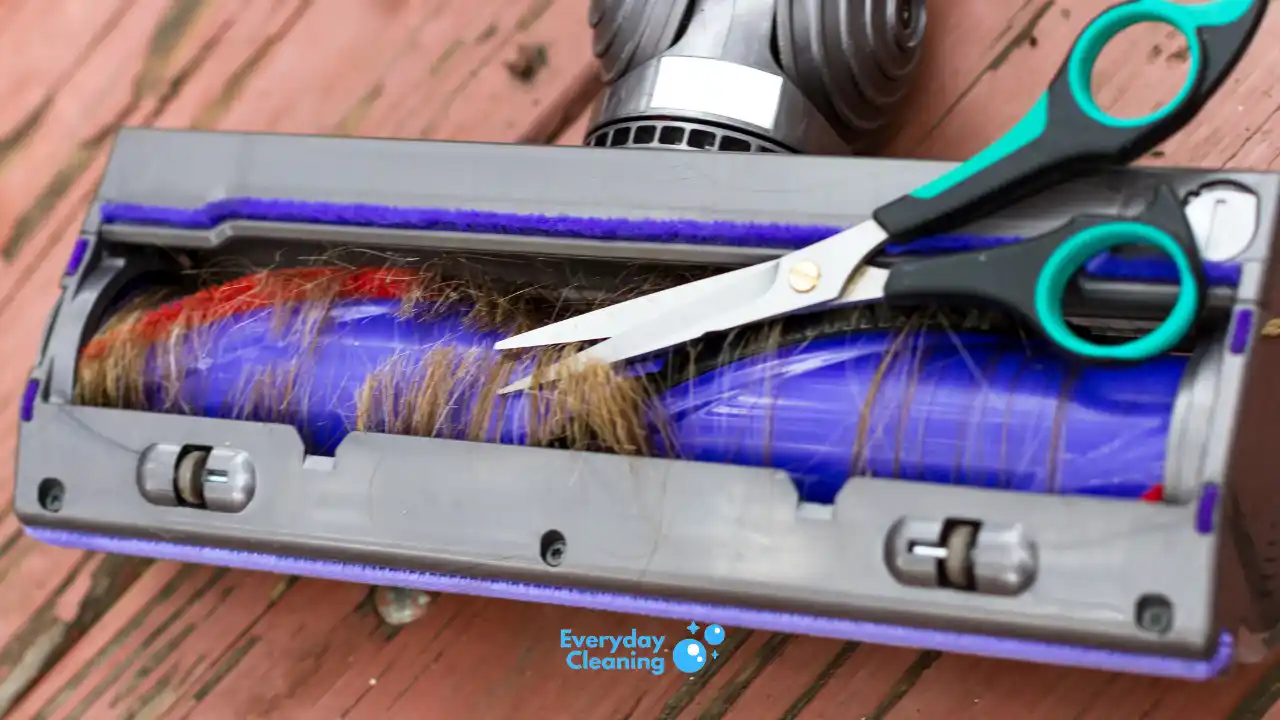
Hold the brush roll firmly with one hand. With scissors, make shallow cuts through the hair at two or three evenly spaced points along the length of the roller.
The key word is shallow. You want to cut the hair, not the bristles underneath. Angle the scissors so the blade runs parallel to the roller surface rather than straight into it. Two or three cuts along the length are enough to break the hair into sections that peel off.
A seam ripper is more precise here. Slide the hook under the hair layer at one end of the roller and run it along the length in one stroke. This cuts through the entire wrap cleanly in one pass with no risk of bristle damage.
Step 5: Peel the Hair Off in Sections
After cutting, the hair comes off in strips. Pull each section away from the roller and dispose of it. Work from both ends toward the center.
The hair packed near the end caps is always the tightest. On some rollers, hair wraps into the recessed area where the axle sits. Use the tip of a seam ripper or a toothpick to loosen hair from these tight spots before pulling.
Step 6: Clean the End Caps and Axle
Remove the end caps if they detach from the roller. Hair wraps around the axle stub underneath and restricts the spin even after the main roller surface is clean. Pull this hair off by hand or use the tip of the seam ripper to loosen it.
This step is the one most people skip. A roller that spins freely by hand but still performs poorly in use usually has hair packed into the end caps or bearings.
Step 7: Brush Out the Bristles
Once the hair is gone, use an old toothbrush to scrub along the bristles. Debris, dust, and fine particles pack into the base of the bristles and are not removed just by cutting hair away.
Scrub from the base of the bristles outward. Do this along the full length of the roller on both sides.
Step 8: Clean the Roller Housing
While the brush roll is out, wipe out the channel it sits in. Hair and debris collect in the housing and can prevent the roller from seating correctly or spinning freely even after cleaning.
Use the toothbrush or a damp cloth to clear out the housing. Check the suction inlet at the back of the head while you have access.
Step 9: Reinstall and Test
Reinsert the roller in the correct orientation. Replace the end caps and base plate. Plug in and run on carpet for 30 seconds. The roller should spin freely and the suction should feel noticeably stronger than before.
Tangled Hair on Robot Vacuum Brush Rolls
Robot vacuums need brush roll cleaning more frequently than standard vacuums because they run unsupervised and encounter every surface in the home on every cycle.
Most robot vacuum brush rolls are shorter and easier to access than upright or stick models. The roller lifts out without tools on most brands. The same cutting and peeling method applies.
Check the side brushes on robot vacuums at the same time. The small spinning brushes at the front corners wrap hair just like the main roller. Pull the side brushes off their pegs and clear any wrapped hair or thread from the base.
Robots used in homes with long hair or pets benefit from weekly brush roll checks. Hair builds up fast enough on a daily-running robot that monthly cleaning is not sufficient. Our roundup of the best robot vacuums for pet hair and allergies covers models with anti-tangle brush designs that reduce how often manual cleaning is needed.
How Often to Remove Tangled Hair
| Household | Frequency |
|---|---|
| Short hair, no pets | Every 2–3 months |
| Long hair or one pet | Monthly |
| Long hair and pets | Every 2–3 weeks |
| Robot vacuum, any household | Weekly check |
The fastest indicator is visual. Flip the vacuum over and look at the roller. If you can see a visible layer of wrapped hair covering the bristles, it needs cleaning now. Do not wait for suction loss or warning lights. By that point the roller may have been slipping for weeks.
Preventing Hair Tangling in the First Place
Vacuum more frequently in shorter sessions. Less hair on the floor per session means less hair wrapping the roller per pass. A quick daily vacuum picks up loose hair before it accumulates into a tangle-prone load.
Use a vacuum with an anti-tangle brush roll. Several current models use spiral-cut or segmented brush designs that cut hair before it can wrap. These are significantly better for long hair and pet households. Our guide to the best cordless vacuums for pet hair includes models with this feature.
Pick up visible hair clumps before vacuuming. Large clumps of shed hair picked up by hand before vacuuming reduce the load going to the brush roll. Takes ten seconds and extends cleaning intervals noticeably.
Check the roller every time you empty the bin. Making it a habit means you catch wrapping early before it becomes a full tangle removal session.
Frequently Asked Questions
Can I remove tangled hair without taking out the brush roll?
You can cut surface hair with scissors while the roller is in place, but you will not reach the hair packed into the end caps and axle areas. Full removal gives better results and takes only a minute or two more.
What is the easiest tool for cutting hair off a brush roll?
A seam ripper. It slides under the hair wrap and cuts through the entire layer in one stroke without any risk of cutting the bristles. Most sewing kits include one and they cost under $5 separately.
How do I know if hair wrapping has damaged the brush roll?
If the bristles are visibly bent, broken, or worn down after hair removal, the roller has taken damage. If the roller still does not spin freely after full cleaning, the belt may be stretched or the bearings may be worn. Either issue means the roller or belt needs replacement.
Does hair wrapping affect vacuum suction?
Yes. A roller that cannot spin freely causes the motor to work harder and generates more heat. Suction drops as airflow through the system is restricted. In severe cases the motor protection shuts the vacuum off to prevent overheating.
My vacuum has an anti-tangle brush roll. Does it still need cleaning?
Yes, less often but not never. Anti-tangle designs reduce wrapping significantly but do not eliminate it entirely. Long hair and fine thread still accumulate over time. Check the roller monthly even on anti-tangle models.
Can I use a vacuum to clean the brush roll itself?
You can use a smaller handheld vacuum to pull loose debris off the brush roll after cutting the hair free. It is faster than a toothbrush for the bristle cleaning step. Our roundup of best handheld vacuums for pet hair includes compact models that work well for this kind of detail cleaning.