The 6 Best Pressure Washers for RVs in 2026
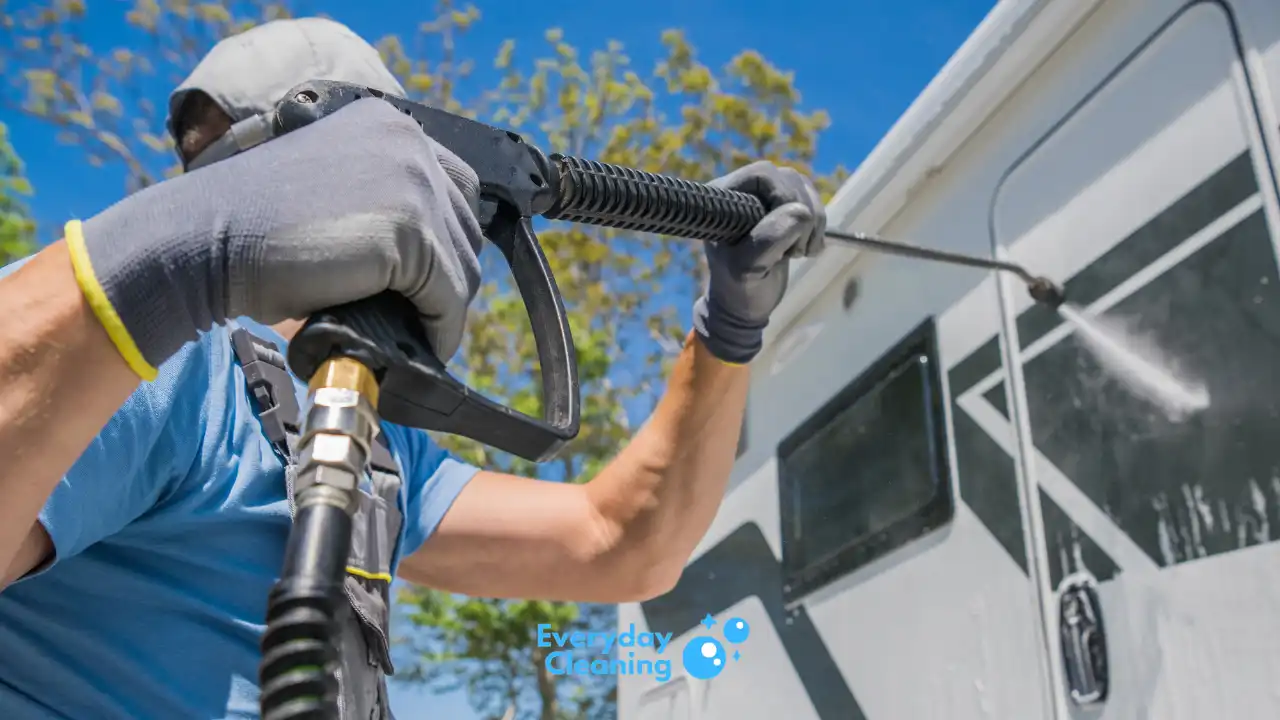
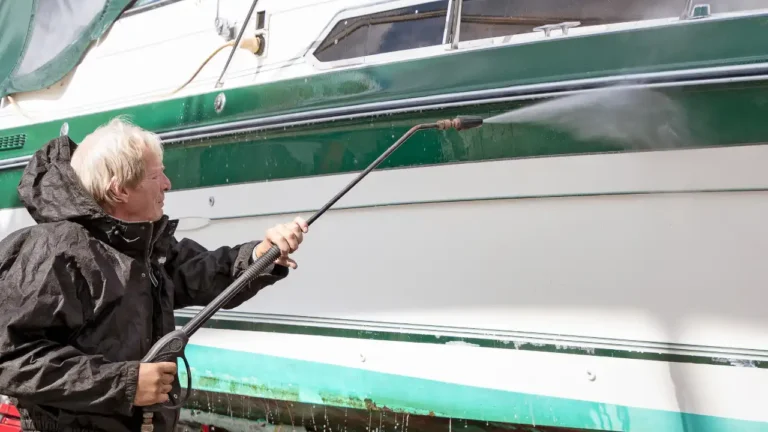
RV exteriors get dirty fast. road grime, tree sap, mildew on the roof, bug splatter across the front cap. A regular garden hose won’t cut it, but the wrong pressure washer can strip decals or crack rubber seals. These six picks hit the right balance for safe, effective RV cleaning.
Our Top Picks
| Recommendation | Product | Reason |
|---|---|---|
| Best Overall | EGO HPW3200 | 3200 PSI cordless with 60 min runtime, no outlet needed at the campsite. Reviews ↓ |
| Best Electric | Westinghouse ePX3500 | 19 lbs, anti-tipping 4-wheel design, 2500 PSI max. Reviews ↓ |
| Best Handheld Cordless | WORX WG647 Hydroshot | Draws from a bucket, true outlet-free, 5.8 lbs. Reviews ↓ |
| Best Budget | Sun Joe SPX3000 | PWMA-certified, 20,000+ reviews, dual soap tanks. Reviews ↓ |
| Best for Gentle Washing | Karcher K1700 | CETA certified, paint-friendly pressure, 25 ft hose. Reviews ↓ |
| Best for RV Detailing | Active 2.0 Pressure Washer | 1100 PSI working pressure, 2.0 GPM, foam cannon. Reviews ↓ |
Best Overall: EGO Power+ HPW3200
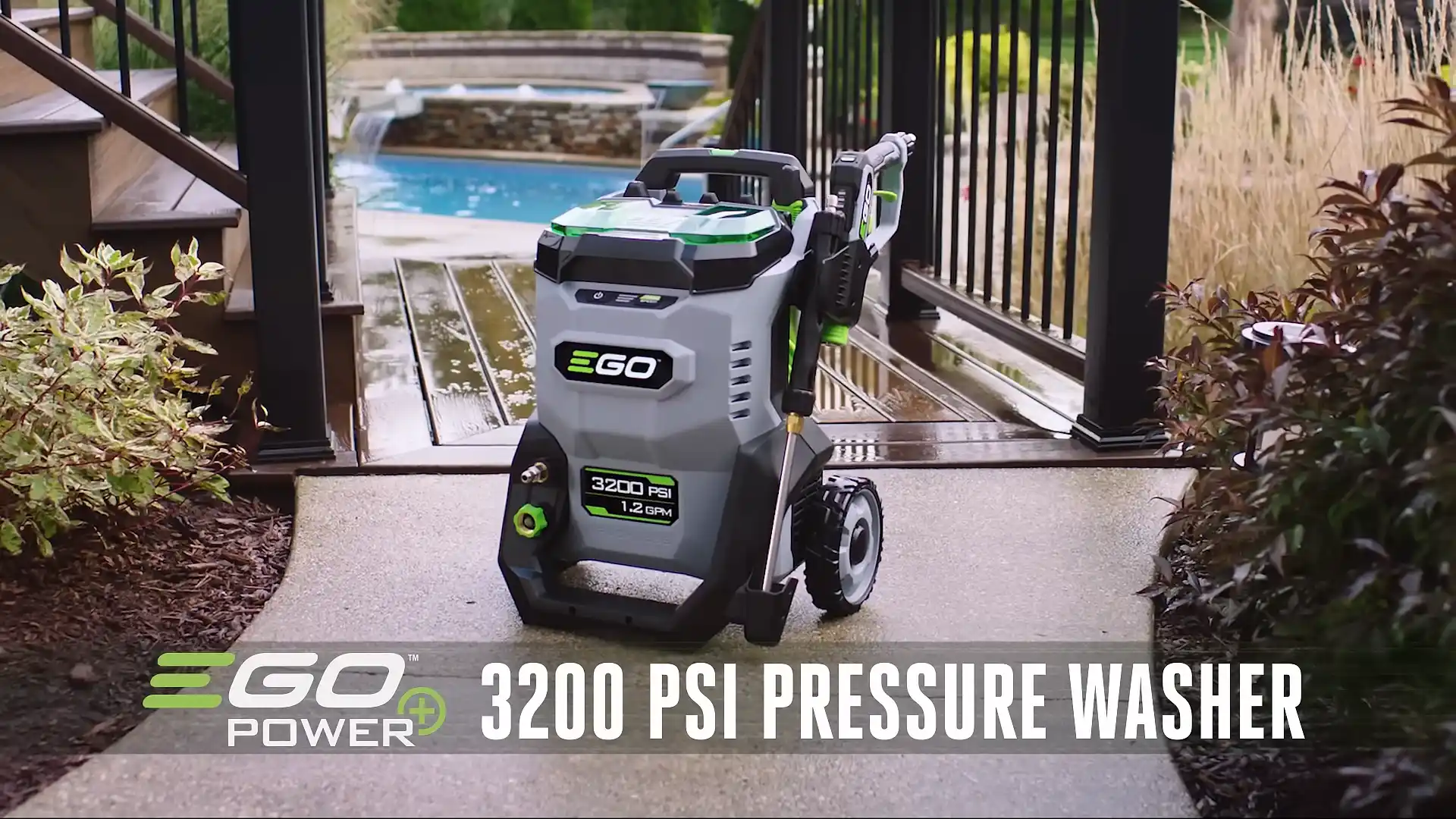
No outlet at the campsite? No problem. The EGO HPW3200 runs entirely on battery and delivers 3200 PSI. more than enough to blast road tar off the undercarriage or scrub mildew off a fiberglass sidewall without hunting for a power hookup.

- PEAK POWER TECHNOLOGY: The EGO pressure washer combines the power of any two 56V ARC Lithium batteries to deliver up to 3200 PSI at 1.2 GPM—and up to 2.0 GPM max—for powerful cleaning.
- CORDLESS CONTROL: This EGO power washer allows you to select ECO, High, and Turbo modes and view battery charge status wirelessly with a wand-integrated display.

Pros and Cons
| Pros | Cons |
|---|---|
| 3200 PSI cordless. strongest battery-powered model available | Expensive at $500-779 depending on kit |
| Up to 60 minutes runtime on two 6.0Ah batteries | |
| ECO / High / Turbo modes selectable from the wand | |
| Works with all EGO 56V PowerShare batteries | |
| Telescoping handle and rugged wheels for campsite transport | |
| 5 nozzles included (15, 25, 40, turbo, rinse) |
Testing Results
PSI and GPM cleaning power: 3200 PSI max with 2.0 GPM peak. Real-world rated output sits closer to 1.2 GPM, which is enough for thorough RV surface rinsing without stripping anything. Stick to the 25 or 40-degree nozzle on fiberglass and decals.
Cordless performance (RV use case): This is the main reason to choose it. No extension cord, no hunting for an outlet at a campsite or in a storage facility. Two 56V batteries run in parallel and the battery level shows right on the wand.
Motor and pump: 56V brushless Peak Power motor. EGO’s dual-battery Peak Power system delivers more consistent pressure than single-battery cordless units.
Nozzle versatility: Five nozzles cover everything from focused undercarriage cleaning (15 degree) to wide-fan rinsing (40 degree). The turbo nozzle is useful for stubborn mud on wheel wells.
Portability and weight: 53 lbs loaded is not light. The telescoping handle and wheels help, but you won’t be carrying this up a ladder. For roof work, you’ll need a long wand extension.
Noise level: Quieter than any gas unit. Campsite-friendly.
Real-world Usage
The EGO is built for RV owners who store their rig off-site or travel to remote campsites where extension cords won’t reach. The 60-minute runtime on two 6.0Ah batteries covers a full-size Class A or fifth wheel in one session. You can also pick up extra batteries and swap mid-wash on a large motorhome.
If you already own other EGO 56V tools. leaf blowers, string trimmers, mowers. the batteries are fully interchangeable. That changes the value calculation significantly.
Best Use Case
Best for RV owners who clean away from home or in locations without reliable power access. Also excellent for EGO battery ecosystem users who want one more use from their existing batteries. Not the right pick if you always clean near a garage outlet and don’t want to pay the premium.
Verdict
The EGO HPW3200 is the most capable cordless pressure washer on the market, and RV owners are exactly who it’s built for. The price is high, but the cordless freedom is real. not a compromise. The 3200 PSI gives you enough range to dial down safe on fiberglass and dial up on grime. If campsite cleaning or off-grid storage is part of your routine, this one earns its cost.
For reference on safe RV washing technique, our best pressure washer for cars guide covers nozzle distance and pressure settings for painted surfaces.
Rating: 4.6 / 5
View on Amazon: EGO HPW3200
Best Electric: Westinghouse ePX3500
Nineteen pounds, 4-wheel 360-degree steering, a 25-foot hose, and 2500 PSI max. The Westinghouse ePX3500 is the most practical corded option for RV owners who clean at home or at a campsite with hookups.
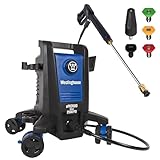
- Delivers 2500 max PSI and 1.76 max GPM (at lowest pressure), and 2000 rated PSI and 1.2 rated GPM of water flow; Pro-style steel extendable 17.5” wand with quick-connect nozzles (0°, 15°, 25°, turbo and soap applicator)
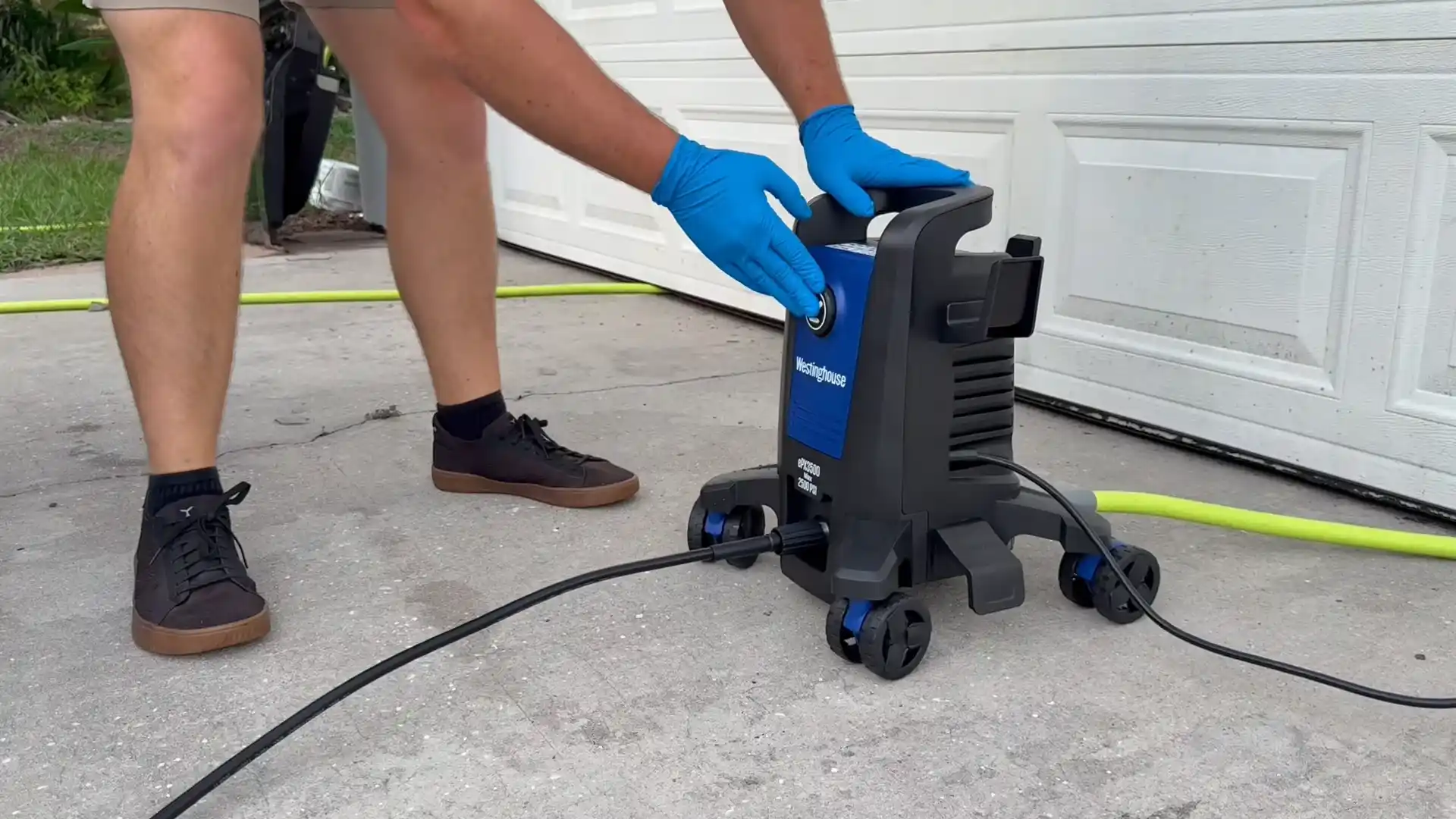
- Super compact and lightweight at 16.5” tall and 19 pounds for convenient storage and portability; Four quick-lock wheels with 360° steering design and low center of gravity engineered for anti-tipping design
Pros and Cons
| Pros | Cons |
|---|---|
| Anti-tipping 4-wheel design with 360-degree steering | Onboard soap tank is only 20 oz (fills fast) |
| Only 19 lbs, easy to reposition around the RV | |
| 25 ft hose gives better reach than most budget models | |
| 5 nozzles including 0-degree | |
| 3-year Westinghouse warranty | |
| TSS pump protection |
Testing Results
PSI and GPM cleaning power: Rated 2000 PSI / 1.2 GPM in actual use. Plenty for RV fiberglass, awnings, and sidewalls. Use the 25 or 40-degree tip on decals and seals. The turbo nozzle works well on wheel wells and hitch areas.
Ease of assembly and setup: Fast. Four wheels lock into place, hose snaps onto the gun, nozzles quick-connect. Ready to spray in under five minutes.
Hose length and reach: 25 ft hose is a step above the 20 ft standard you get at this price. Enough to work around a 28-foot travel trailer without repositioning constantly.
Portability and weight: 19 lbs is genuinely light for an electric unit with this much output. The 4-wheel steering makes it easy to move over gravel or uneven ground without tipping.
Soap delivery: The 20 oz onboard soap tank is the main limitation. You’ll refill it a couple of times washing a full-size RV. Works fine, just plan for it.
Noise level: Quiet for a corded electric. Comfortable to use for a full wash session.
Real-world Usage
This is the sensible pick for most RV owners who clean at a fixed location. Hook it to a standard garden hose, plug it into a 15-amp outlet, and you’re ready. The 4-wheel design means you can roll it around gravel driveways or campsite pads without it flopping over. The 35 ft power cord gives reasonable freedom without needing an extension.
The 3-year warranty is better than most in this price range and Westinghouse’s customer support has a solid reputation for replacement parts.
Best Use Case
Best for RV owners who clean at home or at campgrounds with power hookups. Ideal for travel trailers, fifth wheels, and Class B vans in the 20-30 foot range. For larger Class A motorhomes, consider a longer hose extension.
Verdict
The Westinghouse ePX3500 is the most complete electric pressure washer for RV use at this price. Nothing about it feels cheap or underpowered for typical exterior washing tasks. The anti-tipping design is a real differentiator when you’re working around an uneven campsite.
Rating: 4.5 / 5
View on Amazon: Westinghouse ePX3500
Best Handheld Cordless: WORX WG647 (40V Hydroshot)
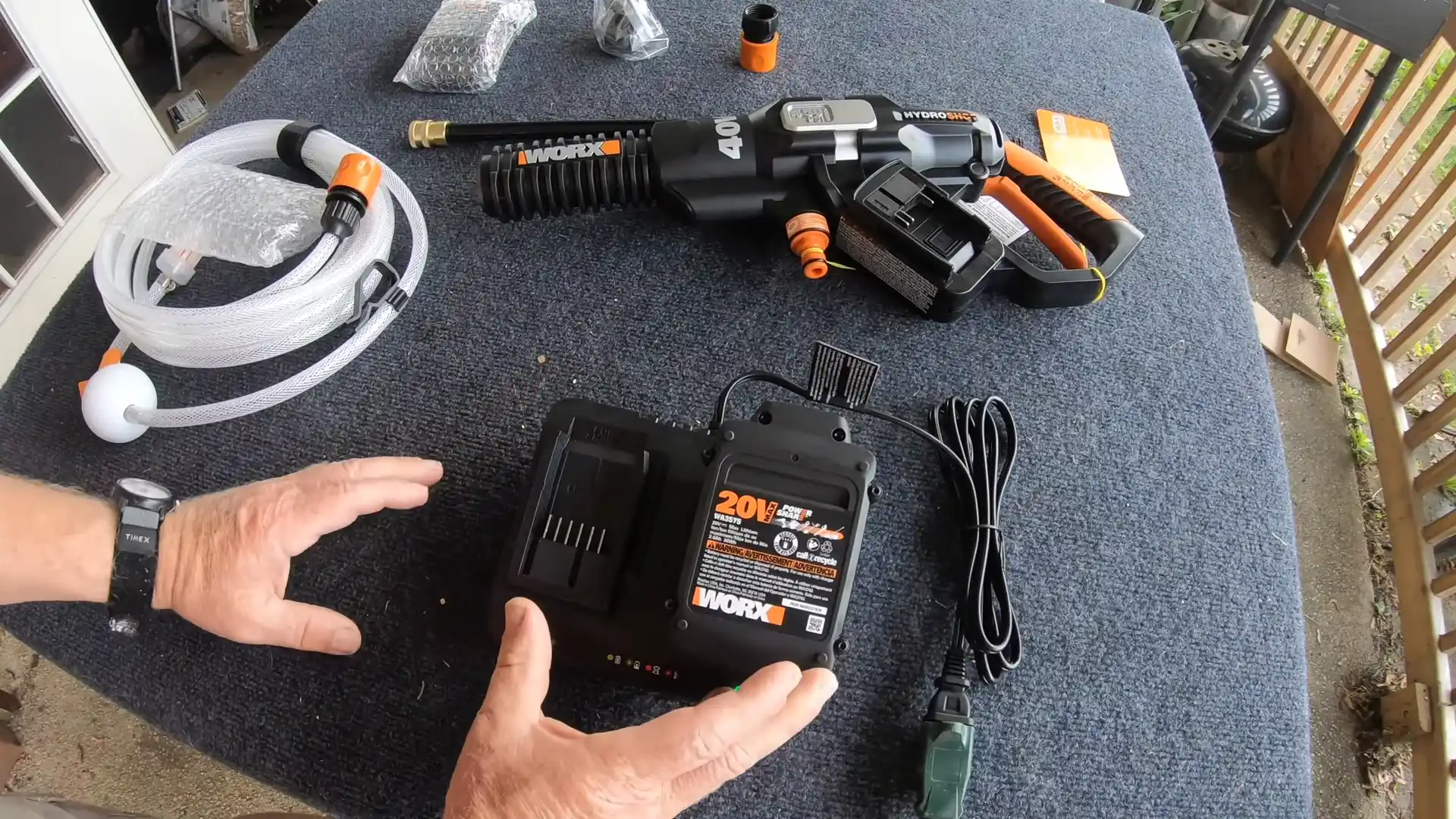
No outlet, no hose hookup. the Hydroshot draws water from a bucket, a lake, or a rain barrel and runs entirely off a 40V battery. At 5.8 lbs and 800 PSI, it’s not a heavy cleaner, but it’s the most portable rinse tool you can take to any campsite.

- Powerful Cleaning Performance: 800 PSI with 1.0 GPM for maximum efficiency in removing grime and debris
- Advanced Motor Technology: Efficient Brushless Motor 2.0 for longer runtime and enhanced durability
Pros and Cons
| Pros | Cons |
|---|---|
| True cordless and hose-free. draws from any water source | 800 PSI is low. won’t remove heavy grime or stains |
| Only 5.8 lbs. lightest pick on this list | 1.0 GPM flow rate is limited |
| 5-in-1 spray nozzle in one attachment | |
| Compatible with all WORX 40V PowerShare batteries | |
| ECO mode extends battery life | |
| Kit includes 2x 2.0Ah batteries |
Testing Results
PSI and GPM cleaning power: 800 PSI and 1.0 GPM. Honest about what it is. Great for rinsing dust and loose grime off RV sidewalls, awnings, and patio furniture. Not enough pressure for caked-on mud, bugs on the front cap, or any surface needing real scrubbing power.
Cordless and hose-free performance: This is the actual reason to buy it. Drop the intake hose into a five-gallon bucket and you have a functioning pressure washer anywhere. No campsite hookup needed.
Nozzle versatility: The 5-in-1 nozzle covers a range from focused jet to gentle fan. All in one attachment. no swapping tips.
Portability and weight: 5.8 lbs is easy to use one-handed. You can rinse the roof line or top of a slide-out without straining. Fits in a storage bay without taking up real space.
Runtime: Two 2.0Ah batteries give roughly 20-30 minutes of continuous use depending on mode. Enough for a quick rinse session. Not enough for a full deep wash on a large motorhome.
Real-world Usage
The Hydroshot fills a specific gap: boondocking, dry camping, or any situation where you want to rinse the rig and have no hookups. It’s also great for quick campsite cleanup. rinsing off chairs, mats, muddy shoes. without hauling out a full-size unit.
Pair it with a 5-gallon bucket and a small bottle of RV wash soap and it covers a basic rinse job on a 20-foot trailer in one battery charge.
Best Use Case
Best for RV owners who want a lightweight rinsing tool for off-grid travel. Not a replacement for a full pressure washer. Also excellent for WORX battery ecosystem users. Skip it if your main job is removing road grime or mildew from a larger rig.
Verdict
The WORX Hydroshot is the right tool for what it is. Don’t expect it to scrub. Do expect it to rinse anywhere you go. For a secondary tool or a dedicated off-grid option, nothing else on this list comes close for convenience.
Rating: 4.2 / 5
View on Amazon: WORX WG647 Hydroshot
Best Budget: Sun Joe SPX3000
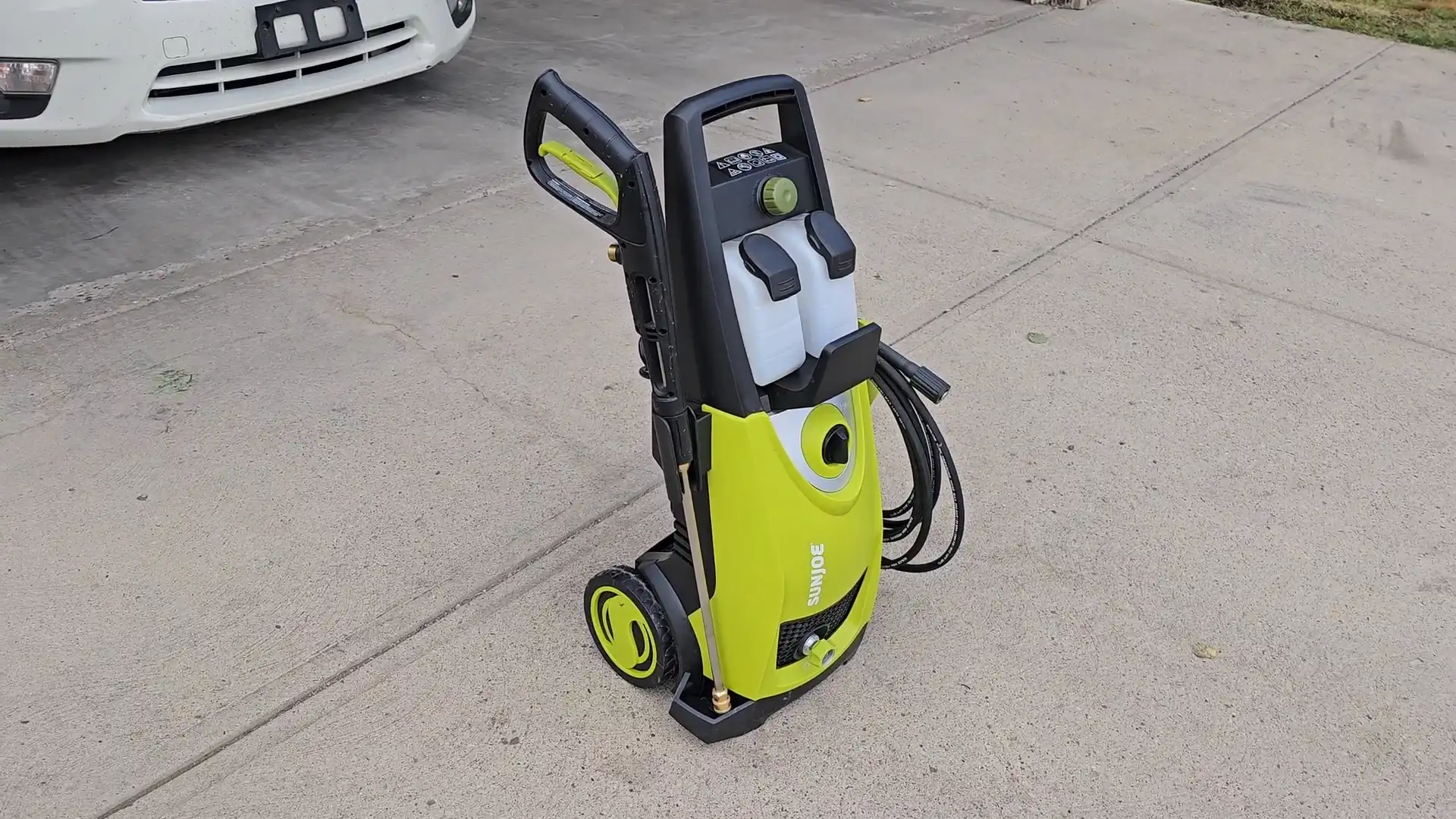
The Sun Joe SPX3000 has more than 20,000 Amazon reviews at 4.8 stars and PWMA certification. For an RV owner who wants a reliable electric at the lowest reasonable price, it’s hard to argue with either number.

- High-Pressure Cleaning: This electric pressure washer delivers up to 2030 PSI working pressure and 1.2 GPM water flow to help remove dirt, grime, and buildup from homes, driveways, vehicles, RVs, and outdoor equipment
- Multiple Spray Options: This water pressure washer includes five quick-connect spray tips (0°, 15°, 25°, 40°, and soap) to switch between narrow jet streams and wider fan patterns, plus a soap applicator for detergent use
Pros and Cons
| Pros | Cons |
|---|---|
| 20,000+ Amazon reviews at 4.8 stars | 20 ft hose feels short on larger RVs |
| PWMA certified (accurate spec ratings) | |
| Dual 0.9L removable detergent tanks. switch soaps mid-wash | |
| 5 quick-connect nozzles including 0-degree | |
| 2030 PSI at a budget price | |
| TSS pump protection |
Testing Results
PSI and GPM cleaning power: 2030 PSI / 1.2 GPM, PWMA verified. Solid for RV sidewalls, awnings, and muddy wheel wells. Not strong enough for heavy oxidation or stuck-on road tar. that needs the turbo nozzle or a dedicated chemical pre-soak.
Nozzle versatility: Five quick-connect tips including 0-degree. The 34-inch wand reaches reasonably high on sidewalls without a ladder for shorter rigs.
Soap delivery: The dual detergent tank is genuinely useful. Fill one with wash soap, one with rinse aid or a second product. Switch between them with a twist. No other unit at this price has this.
Portability and weight: 24.3 lbs with rear wheels. Rolls okay on flat pavement. Struggles on gravel or uneven campsite ground.
Ease of setup: Simple assembly. Snap the wand together, connect the hose, plug it in. Nothing complicated.
Real-world Usage
The SPX3000 is the most popular electric pressure washer on Amazon for a reason. It covers the basics reliably and the dual soap tank is a standout feature for anyone who wants to alternate between a degreaser and a rinse soap during an RV wash session.
The 20 ft hose is the main frustration on a large rig. Pick up a 25-foot pressure washer hose extension and the range becomes much more manageable.
Best Use Case
Best for first-time RV pressure washer buyers or anyone on a tight budget who cleans at home with access to an outlet. Excellent for travel trailers and smaller Class B or C motorhomes. For Class A rigs over 35 feet, the hose length will annoy you.
Verdict
The Sun Joe SPX3000 is a proven performer at a proven price. It’s been the budget recommendation for years because the fundamentals are right: PWMA certification, five nozzles, dual soap tanks, and an enormous review base that confirms long-term reliability. Nothing flashy, just a solid tool.
For tips on getting the most out of a mid-range electric on outdoor surfaces, see our guide to the best pressure washer for patios.
Rating: 4.3 / 5
View on Amazon: Sun Joe SPX3000
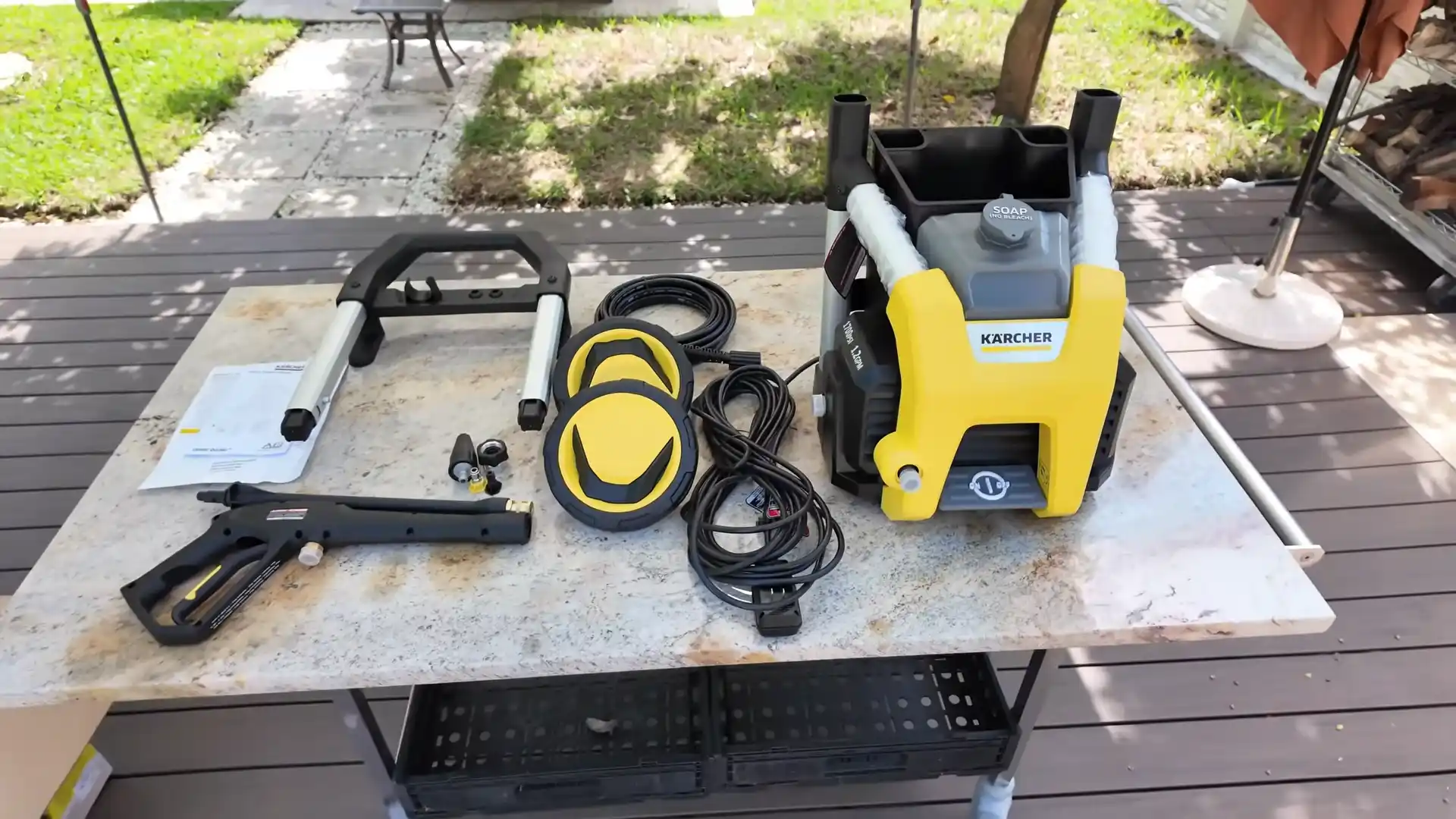
Best for Gentle RV Washing: Karcher K1700
CETA-certified and car-wash optimized, the Karcher K1700 is built for surfaces where you want flow over raw force. At 1700 PSI, it’s safer on decals, painted fiberglass, and rubber seals than anything pushing 2500 PSI or higher.

- POWERFUL & CETA CERTIFIED: 1700 PSI TruPressure and 1.2 GPM for effective cleaning of various surfaces. Independently tested and CETA certified for proven performance you can trust.
- VERSATILE CLEANING OPTIONS: Equipped with three different nozzles (15°, turbo, and 65°), the K1700 allows you to tackle a wide range of cleaning jobs with precision
Pros and Cons
| Pros | Cons |
|---|---|
| CETA certified. specs you can trust | Pricier than Craftsman or RYOBI at similar power output |
| 25 ft hose (longer than most budget models) | |
| Foot on/off switch. no bending to reach the unit | |
| Removable detergent tank | |
| Never-flat wheels for campsite movement | |
| Strong Karcher brand reliability |
Testing Results
PSI and GPM cleaning power: 1700 PSI / 1.2 GPM, CETA certified. Safe range for all RV exterior surfaces including gel coat, vinyl graphics, and rubber roof edges. Not the pick for mud-caked wheel wells or hard water deposits.
Car and RV wash performance: Yes. The Vario spray wand lets you dial pressure continuously rather than swapping nozzles. That’s a practical advantage when you’re moving between the RV body and something more delicate like trim or window seals.
Ease of setup: The foot switch is a small but real convenience. No reaching down to flip a switch mid-wash. Never-flat wheels mean you can park it and forget about flat tires.
Hose length and reach: 25 ft is the longest hose on a budget model in this category. Enough to reach across a 30-foot trailer from one position without dragging the unit every five minutes.
Soap delivery: Removable detergent tank detaches cleanly. Fill and attach before washing, remove when done.
Real-world Usage
The K1700 is the right pick for RV owners who are more worried about damaging their rig than they are about cleaning power. Fiberglass decals, rubber slide-out seals, and painted aluminum caps all respond better to 1700 PSI and good technique than to aggressive pressure and a narrow nozzle.
The Karcher brand has been making pressure washers for decades. Build quality and part availability are better than generic brands at the same price.
Best Use Case
Best for owners of expensive RVs where safe cleaning matters as much as clean results. Also good for anyone dealing with older or faded fiberglass that could peel under higher pressure. Skip it if your rig is heavily soiled or if you also need to clean a driveway with the same unit.
Verdict
The Karcher K1700 is the conservative choice, and for RV cleaning that’s often the right call. The CETA certification, 25 ft hose, and foot switch make it a more practical machine than its spec sheet suggests. If preserving your paint and decals is the priority, this is the one to consider.
Rating: 4.2 / 5
View on Amazon: Karcher K1700
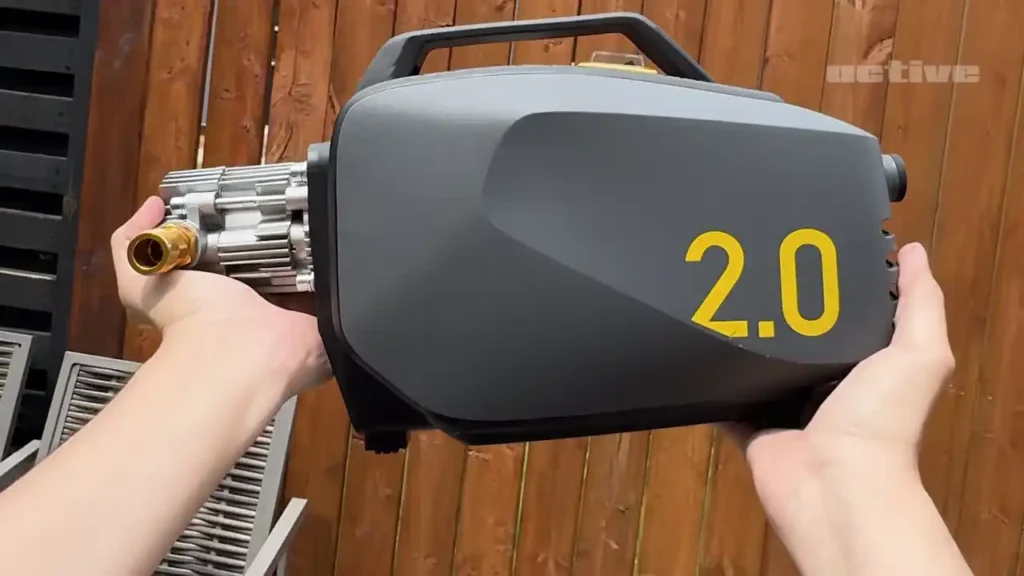
Best for RV Detailing: Active 2.0
The Active 2.0 runs at 1100 PSI in real use with 2.0 GPM flow. That combination is specifically engineered for foam cannon performance. safe on clear coat, great at soaking loose grime before contact washing. RV detailers use it for the same reason car detailers do.

- Fast and deep cleaning - The Active 2.0 set industry benchmark 2.0 GPM cleaning power to blast away dirt and grime in less time, perfect for everything from cars to patios.
- Easy to move and store - The Active 2.0 is light, compact, allowing for versatile applications and ease of storing once done with your wash
Pros and Cons
| Pros | Cons |
|---|---|
| 1100 PSI working pressure is safe on gel coat and decals | Expensive for the PSI output compared to budget electrics |
| 2.0 GPM flow rate. best foam cannon performance on this list | 1100 PSI limits heavy-duty cleaning tasks |
| 5-piston pump rated for 250 hours of use | No wheels. compact box design, carry only |
| Compact form factor (smaller than a 3-gallon jug per users) | Foam cannon typically sold separately unless buying the full kit |
| Strong community following on r/AutoDetailing | Shorter 25 ft cord |
| TSS pump protection | No PWMA/CETA certification |
Testing Results
PSI and GPM cleaning power: 1100 PSI operating pressure, 2.0 GPM. The high flow is what enables dense foam application. Thick foam clings longer to vertical RV surfaces and lifts more grime before you touch the paint.
Foam cannon performance: Best on this list. The 2.0 GPM flow produces the kind of thick lather car detailers prefer. For RV owners who pre-soak the exterior before hand washing, this is a meaningful advantage.
Motor and pump: 5-piston pump rated 250 hours is significantly more durable than the axial cam pumps on most budget electrics. Long-term cost of ownership is lower.
Portability and weight: 24 lbs in a compact box form. No wheels, but the size means it fits easily in an RV storage bay. Cord and hose coil small.
Surface performance: Yes on car wash, patio furniture, light deck work. No on concrete, heavy stains, or siding cleaning. the pressure is too low.
Real-world Usage
This is a two-machine approach. You use the Active 2.0 for foam application and contact washing where you want paint safety and good soap coverage. For anything heavy-duty. black streaks on aluminum, hard water deposits on fiberglass, or undercarriage grime. you’d reach for a higher PSI unit.
RV detailing enthusiasts who already follow a multi-step wash process will find this fits naturally into that workflow.
Best Use Case
Best for RV owners who detail their rig regularly and want to protect the gel coat or paint finish. Also a good pick for anyone pairing pressure washing with a soft brush or wash mitt on expensive custom graphics. Not the right choice for first-time buyers who want one tool for all jobs.
Verdict
The Active 2.0 occupies a specific niche and does it very well. It’s for the RV owner who treats washing as part of a maintenance routine, not just a cleanup task. The 250-hour pump rating means you’ll get years of use out of it if you use it right.
For detailing-focused product pairings, our best pressure washer for car detailing article covers soap, foam cannon setup, and technique.
Rating: 4.4 / 5
View on Amazon: Active 2.0 Pressure Washer
What Makes the Best Pressure Washer for RV?
Safe PSI Range for RV Exteriors
RV surfaces are not driveway concrete. Fiberglass gel coat, vinyl decals, rubber seals around windows and slide-outs, and painted aluminum panels all require controlled pressure. The general safe range for RV cleaning is 1200 to 2200 PSI. Below 1000 PSI and you’re mostly rinsing. Above 2500 PSI on a narrow nozzle and you risk lifting decals, forcing water under seams, or marking gel coat.
The nozzle angle matters as much as the PSI number. A 40-degree wide fan at 2000 PSI is safer than a 15-degree pencil jet at the same pressure. On painted or gel coat surfaces, keep your distance at 18 to 24 inches and use the widest nozzle that still moves the dirt.
Corded Electric vs. Cordless for RV Use
Corded electric models deliver consistent pressure and unlimited runtime, which makes them practical for a full wash session on a large Class A motorhome. The limitation is obvious: you need an outlet within reach. At a campground with hookups or at home, that’s not a problem. At a remote campsite or an off-site storage facility, it becomes one fast.
Cordless models like the EGO HPW3200 solve the outlet problem but add weight and cost. Battery runtime is a real limitation on large rigs. plan to have a second charged battery ready if you’re washing something over 30 feet. The WORX Hydroshot takes cordless one step further by removing the hose requirement entirely, which makes it practical in truly remote situations where even the water supply is limited.
GPM and Flow Rate
Cleaning power on an RV comes from a combination of PSI and GPM. GPM is often overlooked. Higher flow rate means more water volume hitting the surface per minute, which helps soap penetrate and grime lift faster without needing extreme pressure. A 2.0 GPM model at 1200 PSI often cleans better than a 1.0 GPM model at 2000 PSI on painted surfaces.
For foam cannon users, GPM matters most. Foam cannons need adequate flow to produce thick lather. Anything below 1.5 GPM tends to produce thin foam that drips off vertical surfaces before it has time to work.
Portability and Setup at the Campsite
The best RV pressure washer is the one you’ll actually carry and use. A 53-pound unit with wheels is manageable at a fixed location. At a campsite where you’re carrying it across gravel, it becomes a workout. Think about where you’ll be cleaning most often before choosing.
Hose length also matters more on an RV than on a car or driveway. Rigs over 30 feet require at least a 25-foot hose and likely an extension to reach from one end to the other without repositioning the machine constantly. A 20-foot hose feels short immediately on anything longer than a 24-foot trailer.
Nozzle Selection for Different RV Surfaces
Most pressure washers include 4 to 5 quick-connect nozzles, and for RV cleaning, the angle selection matters. The 40-degree wide fan is your safest all-purpose tip for painted surfaces, slide-outs, and awnings. The 25-degree is good for siding, wheel wells, and storage bay doors. The 15-degree concentrates pressure. useful for the hitch area, black streak removal on aluminum, and stubborn muddy areas on the undercarriage.
Avoid the 0-degree nozzle on any gel coat, painted surface, or flexible material. It concentrates too much force in too small an area. Reserve it for concrete or metal undercarriage parts if you use it at all.
Frequently Asked Questions
What PSI is safe for washing an RV?
Most RV manufacturers recommend staying between 1200 and 2000 PSI for exterior washing. Anything over 2500 PSI on a narrow nozzle risks peeling decals, forcing water into seams, or leaving pressure marks on gel coat. Use a 25-degree or 40-degree nozzle and keep at least 18 inches of distance from the surface. Our best portable pressure washer guide covers light-duty options that are safe for sensitive surfaces.
Can I use a pressure washer on an RV roof?
Yes, with care. Most RV roofs are rubber (EPDM or TPO) or fiberglass. Use the 40-degree nozzle, keep pressure under 1500 PSI, and stay at least 12 inches away from any seams or vents. Never use a turbo or 0-degree nozzle on a rubber roof. A long wand extension lets you reach the roof from the ground, which is safer than working from a ladder while holding a spray gun.
Do I need a special soap for RV washing?
Standard car wash soaps work on most RV exteriors. For gel coat and fiberglass, choose an automotive wash that’s pH-balanced and safe for clear coat finishes. Avoid dish soap and household degreasers. they strip wax and protective coatings. Some RV owners use dedicated RV wash concentrates, which are formulated to be safe on decals and rubber seals. The best car wash soap for pressure washer article covers compatible options that work well through a foam cannon.
Is a cordless pressure washer powerful enough for an RV?
Depends on the model. A WORX Hydroshot at 800 PSI is good for rinsing but won’t move embedded grime. The EGO HPW3200 at 3200 PSI handles everything a corded electric can and adds outlet-free flexibility. For full RV exterior cleaning at a campsite without hookups, a premium cordless like the EGO is the practical solution.
How do I remove black streaks from the side of my RV?
Black streaks on RV aluminum or fiberglass sidewalls are usually a combination of oxidation, road soot, and water runoff from roof vents. Pre-treat with a dedicated black streak remover or an RV-specific degreaser, let it dwell for a few minutes, then wash with a 25-degree nozzle at 1500-2000 PSI. Avoid scrubbing aggressively on painted surfaces. the pre-treatment does the work. For siding cleaning on surfaces like this, our best pressure washer for vinyl siding article covers technique and product pairing.