
How to Clean Concrete Driveway with a Pressure Washer (The Right Way)
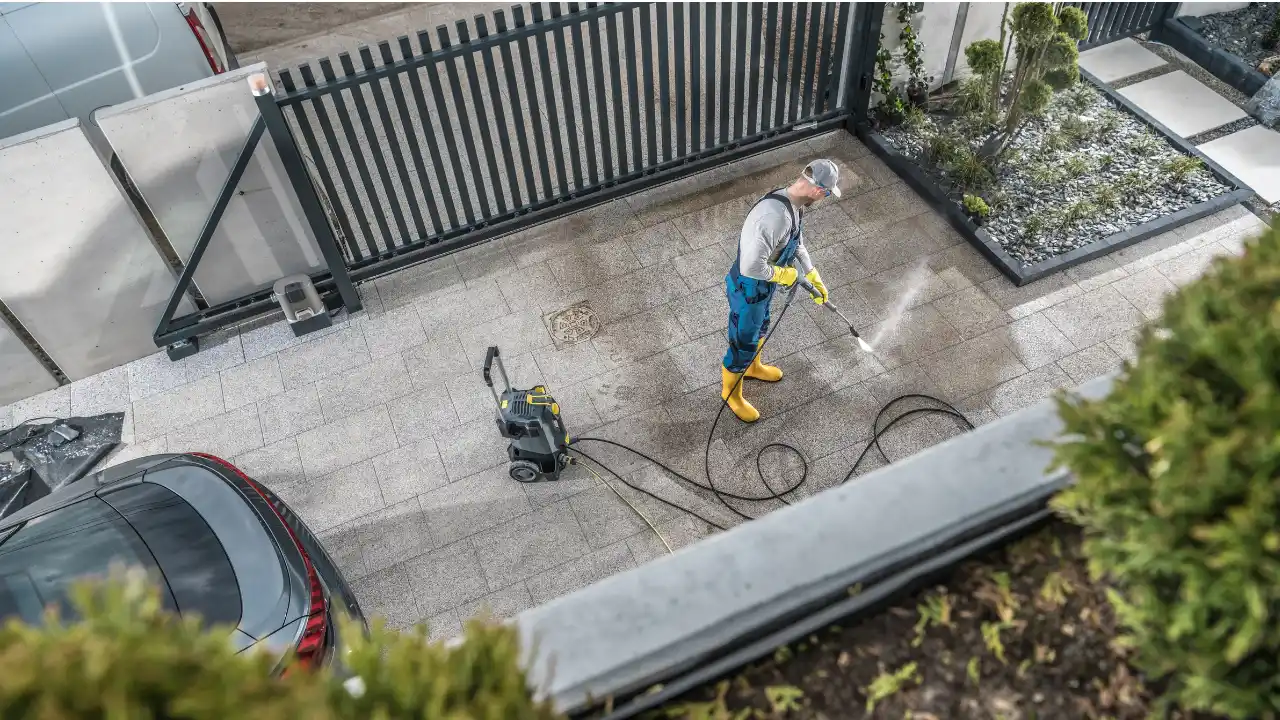
Most people grab a pressure washer wand and start blasting across their driveway. It works, sort of. But it takes forever, leaves wave marks, and wears you out halfway through. There’s a better way to do this, and once you try it, you won’t go back.
What You Need Before You Start
You don’t need a ton of gear for this job. But the equipment choices matter more than most people realize.
Pressure Washer
For a concrete driveway, you want a gas-powered pressure washer in the range of 3,000 to 3,200 PSI with a flow rate of at least 2.0 to 2.5 gallons per minute. That combination of pressure and volume is what actually breaks up dirt and moves it off the surface quickly.
Electric pressure washers are convenient, but most max out around 2,000 PSI with lower flow rates. That’s fine for cars or light patio furniture. For a full concrete driveway, you’ll end up spending twice as long and still not get the same result. If you’re still deciding between the two, our electric vs gas pressure washer comparison breaks down exactly where each type makes sense.
A mid-range gas pressure washer from a home improvement store runs around $300 to $400 and handles driveways, decks, and siding with no problem.
Surface Cleaner Attachment
This is the part most people skip, and it makes the biggest difference. A surface cleaner is a circular attachment that connects to your pressure washer hose and spins two small nozzles just above the ground.
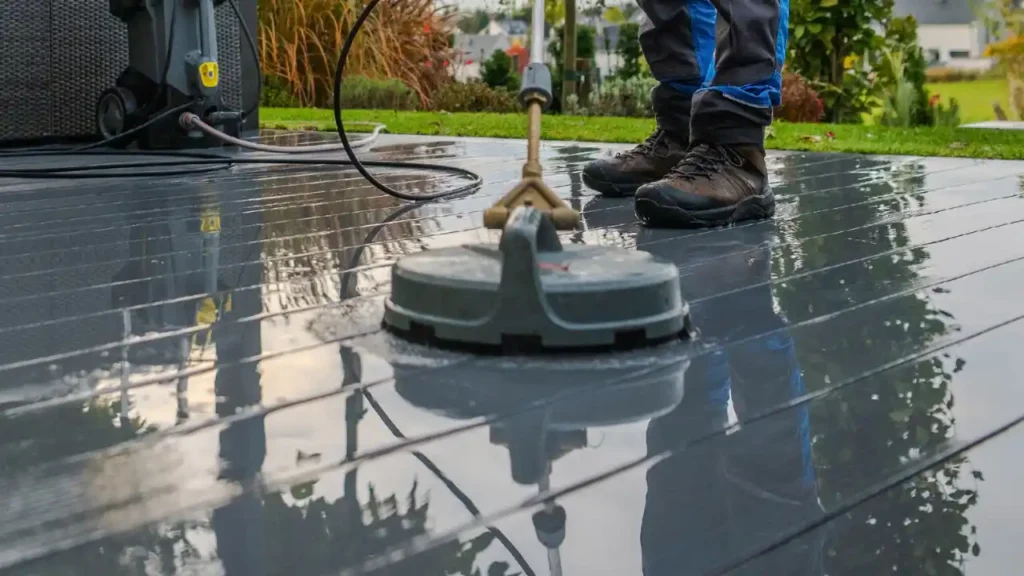
Because both nozzles stay at a constant height and spin at a consistent speed, you get an even clean across the whole surface. No wave patterns. No missed strips. Much faster than sweeping a wand back and forth.
A solid 15-inch surface cleaner with three wheels costs around $100 on Amazon. The wheels matter. They keep the head at a steady distance from the concrete and let you push it across the driveway without fighting it. Models without wheels can skip and drag, especially on uneven surfaces.
You’ll still want to keep a 40-degree spray tip handy for the wand. More on that below.
That’s It
No cleaning solution needed. No pre-soak or post-treatment for a standard dirty driveway. Just water, the right equipment, and a plan.
If you have oil stains, treat those separately with a degreaser and a scrub brush before you start pressure washing. The pressure washer alone won’t fully remove set-in oil.
How to Clean a Concrete Driveway with a Pressure Washer
Step 1: Plan Your Direction
Start at the highest point of your driveway and work toward the lowest. On most residential driveways, that means starting near the garage and working toward the street.
Here’s why this matters. As you clean, you’re pushing dirty water and debris across the surface. If you start at the low end and work up, that mud and grime flows back over concrete you already cleaned. Start high, let it drain toward the dirty sections, and keep moving in one direction.
Step 2: Attach the Surface Cleaner
Connect the surface cleaner to your pressure washer hose where you would normally attach the wand. Most surface cleaners use the same quick-connect fitting.
Keep your 40-degree wand tip in your pocket. You’ll need it at the end of each section to rinse off the loosened dirt.
Step 3: Make Your First Pass
Push the surface cleaner steadily across the concrete. You don’t need to go slow. A comfortable walking pace works well. The spinning nozzles handle the scrubbing. Your job is to keep it moving in straight, slightly overlapping lines.
Work in manageable sections, maybe 6 to 8 feet wide, rather than trying to cover the whole driveway in one direction. This keeps the job organized and makes the rinse step easier.
Step 4: Rinse Each Section
After cleaning a section with the surface cleaner, switch to your wand with the 40-degree tip. Spray off the loosened mud and dirt so it drains off the driveway. This keeps the wet debris from settling back onto cleaned concrete as you continue.
Then move to the next section and repeat.
Step 5: Hit Problem Spots with the Wand
Some areas will need extra attention. Spots with mold, mildew, or heavy staining won’t always come clean with a single pass of the surface cleaner.
For these areas, swap to your wand. Use the 40-degree tip and work the spot directly. Take your time here. The wand gives you more focused pressure on a small area, which is exactly what stubborn stains need.
If the surface cleaner handles the bulk of your driveway but the wand gets the tough corners and stains, you’re using both tools exactly right.
Step 6: Final Rinse
Once you’ve worked through the whole driveway, do a final rinse pass with the 40-degree tip across the full surface. This clears any remaining debris and gives you a look at what still needs attention before you pack up.
Let the driveway dry completely before assessing the results. Wet concrete always looks darker and more uneven than dry concrete.
How Long Does It Take?
For a driveway around 1,800 square feet, expect roughly 1 hour and 45 minutes using a surface cleaner and a 3,100 PSI gas pressure washer. That same job with only a wand would take significantly longer and produce worse results.
Gas consumption for a job that size is about 1.5 gallons.
Should You Rent or Buy?
Renting a gas pressure washer and surface cleaner for a day typically costs $130 to $150. If you only clean your driveway once a year, renting makes sense.
If you already own a pressure washer, adding a surface cleaner for around $100 is an easy upgrade. You’ll use it for decks, patios, and sidewalks too, so it pays off quickly.
If you’re starting from scratch, a mid-range gas pressure washer and a surface cleaner together runs about $450 to $500. Two or three uses and it’s paid for itself compared to renting.
How to Store Your Pressure Washer After the Job
One mistake worth avoiding: storing a gas pressure washer without pump protector fluid.
If your pressure washer sits unused for six months or more, the seals inside the pump can dry out and crack. When it’s time to use it again, you may find it won’t hold pressure or won’t start cleanly.
Pump saver fluid takes about 60 seconds to apply. Connect the bottle to the water inlet, run it through until it comes out the high-pressure end, then disconnect and store. That simple step can extend the life of your pump by years.
Frequently Asked Questions
Can I use dish soap or cleaning solution in a pressure washer to clean concrete?
For a standard dirty driveway, plain water with a surface cleaner is enough. If you want to add a cleaning solution, use one formulated for pressure washers and apply it as a pre-soak with a low-pressure soap tip. Let it sit for a few minutes, then clean as normal. Dish soap is not recommended because it can leave residue and may damage some pump seals over time.
What PSI do I need to clean a concrete driveway?
For concrete driveways, 2,500 to 3,200 PSI is the practical range. Below that, you’ll work harder and still get a less consistent result. Above that, you risk etching the concrete surface, especially on older or lower-quality poured concrete. Pair PSI with flow rate. A high PSI with a low GPM (gallons per minute) won’t move debris effectively.
How often should you pressure wash a concrete driveway?
Once a year is typical for most homeowners. If your driveway is under heavy tree cover or gets a lot of traffic, twice a year may make sense. Cleaning too frequently with high pressure can gradually wear the surface over many years, so more is not always better.
Will a pressure washer remove oil stains from a concrete driveway?
Pressure washing alone usually won’t remove deep oil stains. For those, apply a concrete degreaser to the stain, scrub it in with a stiff brush, and let it sit before pressure washing. You may need to repeat the process for older or heavier stains. Some stains that have been there for years may not come out completely regardless of method.
Do I need to seal my concrete after pressure washing?
Sealing is optional but can help protect the surface and extend the time between cleanings. If you notice the joints and cracks more after cleaning, that’s a good time to look at filling them before applying a sealer. Cleaning first and sealing after is the correct order.



One Comment
Comments are closed.